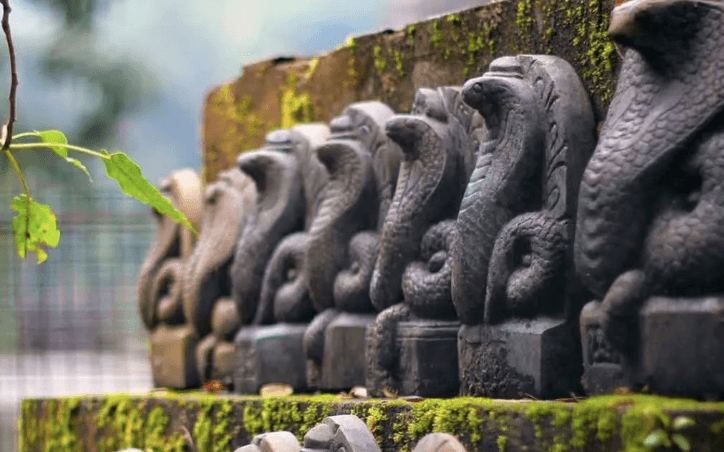
Snake village in Maharashtra
Author : adminPublished : March 28, 2026
In the drought-prone plains of Solapur district, Maharashtra, lies a village that overturns every known rule of human–wildlife interaction. Shetpal, home to roughly 2,600 people, is globally unique for one reason: humans and venomous cobras live together without fear, cages, or barriers—and have done so for centuries.
Unlike wildlife sanctuaries or protected forests, Shetpal is a fully inhabited agricultural village where snakes roam freely inside homes, schools, temples, and farms. Cobras rest in ceiling rafters, curl inside wall niches, and slither across courtyards without triggering panic. Instead of snake repellents, every household maintains a devasthanam—a dedicated snake shrine—where milk and offerings are placed daily.
What makes Shetpal extraordinary is not just the presence of snakes, but the absence of harm. Despite thousands of close encounters with highly venomous species, no fatal snakebite has ever been officially recorded in the village. This zero-incident history, documented in regional gazetteers and oral records, spans hundreds of years.
Shetpal’s coexistence model is rooted in Nag worship, particularly reverence for the cobra as a guardian deity. Children grow up learning to respect snake space, adults never attempt to kill or relocate serpents, and fear is culturally engineered out of daily life. This has resulted in what researchers describe as a biocultural equilibrium—a rare case where belief systems actively shape safer ecological outcomes.
In an era where snakebite deaths remain a major public health issue in rural India, Shetpal stands as a living counter-example, challenging conventional ideas of safety, conservation, and coexistence.
| population of Maharashtra | literacy rate of Maharashtra | sex ratio of Maharashtra |
2. Location Deep Dive: Solapur’s Serpent Heartland
2.1 Geographic Context

Shetpal is located in Mohol taluka of Solapur district, approximately 45 km from Solapur city and 200 km southeast of Pune. The village sits within the Deccan plateau, characterised by rocky soil, sparse vegetation, and a hot semi-arid climate—conditions that are naturally favourable for snake habitation.
| Attribute | Details |
| State | Maharashtra |
| District | Solapur |
| Taluka | Mohol |
| Population | ~2,600 |
| Households | ~520 |
| Climate | Hot semi-arid |
| Elevation | ~500 m ASL |
| Nearest Railhead | Katphal (20 km) |
2.2 Ecological Suitability for Snakes
Shetpal’s environment creates an ideal micro-habitat for cobras:
- Rocky outcrops → natural nesting crevices
- Agricultural fields → high rodent population
- Seasonal monsoon flooding → water availability
- Mud-plastered homes → thermal comfort
Unlike forest-fringe villages where snakes are accidental intruders, in Shetpal the built environment itself accommodates serpents, making conflict unlikely.
3. Historical Foundation: A 500-Year Human–Snake Covenant
The origins of Shetpal’s snake reverence trace back over five centuries, blending mythology, lived experience, and adaptive survival strategies.
3.1 Mythological Origins
Local legend recounts that during a severe famine in the 15th century, a cobra—believed to be Shesh Nag, the cosmic serpent—protected the village granaries from destruction. Following this event, villagers vowed to never harm snakes, instead inviting them into their homes as protectors.
Over time, this vow evolved into a structured belief system.
Key milestones:
- 15th century – First household snake shrines
- 16th century – Temple-level codification of Nag worship
- 18th century – Siddheshwar Temple recognised for snakebite cures
- 1974 – District Gazetteer documents 100 successful snakebite treatments
3.2 Institutionalisation of the Covenant
What distinguishes Shetpal from symbolic snake worship elsewhere is institutional continuity. Snake reverence is not limited to festivals—it is embedded into daily routines, architecture, and social rules.
| Element | Practice |
| Devasthanam | Mandatory in every household |
| Offerings | Daily milk and grains |
| Naming | Household snakes given divine names |
| Temple Authority | Ritual oversight and oral records |
This long-standing covenant transformed snakes from threats into spiritual stakeholders in village life.
4. Devasthanam Network: 520 Snake Shrines Embedded in Homes

Perhaps the most visually striking feature of Shetpal is its network of snake shrines integrated into ordinary buildings.
4.1 Architectural Integration
Every one of Shetpal’s 520 households contains a devasthanam—a hollow niche or rafter space specifically designed for snakes.
| Location | Shrine Function |
| Homes | Primary resting space for cobras |
| Schools | Ceiling niches (non-intrusive) |
| Shops | Countertop or wall shrines |
| Farms | Boundary shrines |
| Siddheshwar Temple | Central cobra sanctum |
These shrines are open, not enclosed, allowing snakes to come and go freely.
4.2 Daily Worship Protocol
Daily interaction with snakes is ritualised, not chaotic.
Typical morning routine:
- 1. Milk placed in shrine (≈50 ml)
- 2. Vermilion mark applied to shrine lintel
- 3. Grains scattered nearby
- 4. Short prayer or recitation
By treating snakes as honoured guests rather than intruders, villagers eliminate sudden movements and panic—key triggers for snake aggression.
5. Zero Snakebite Record: A Statistical Anomaly
From a public health and ecological standpoint, Shetpal’s zero-bite record is its most astonishing feature.
5.1 Verified Safety Metrics
| Period | Population | Encounters | Bites | Fatalities |
| Historical (500+ yrs) | Variable | Daily | 0 | 0 |
| 1974 (Gazetteer year) | ~2,000 | Thousands | 0 | 0 |
| 2026 estimate | ~2,600 | Continuous | 0 | 0 |
While occasional snakebites may occur in surrounding villages, Shetpal remains an outlier.
5.2 Why Bites Don’t Happen
Researchers and observers identify several reinforcing factors:
- Snakes are never startled or cornered
- Humans understand snake territorial behaviour
- No killing → no defensive aggression
- Fear response is culturally absent
- Snakes are well-fed → reduced hunting stress
The result is a rare mutual behavioural adaptation, where both species learn coexistence cues over generations.
6. Nag Panchami: The Annual Serpent Convergence
The spiritual heart of Shetpal’s coexistence model is Nag Panchami, celebrated during the Shravan month.
6.1 Festival Structure
| Ritual | Scale | Duration |
| Milk Abhishek | All 520 shrines | 5 days |
| Idol Bathing | Siddheshwar Temple | 1 day |
| Live Cobra Procession | Village perimeter | ~3 hrs |
| Sweet Distribution | ~10 quintals | Festival period |
Live cobras are handled calmly, without force, under community supervision.
6.2 Collective Participation
- 100% household involvement
- Visitors from neighbouring villages
- No cages, hooks, or sedation
- Zero incidents recorded historically
For Shetpal, Nag Panchami is not spectacle—it is annual renewal of a centuries-old covenant.
7. Children and Snakes: Fearless Coexistence from Infancy
In Shetpal, fear of snakes is not unlearned—it is never taught. From infancy, children grow up seeing cobras not as threats, but as normal household cohabitants. This early social conditioning plays a decisive role in the village’s zero-bite record.
7.1 Childhood Socialisation Process
Unlike urban or rural settings where snakes are framed as dangers, Shetpal’s children encounter serpents in controlled, ritualised contexts.
| Age Group | Interaction with Snakes |
| 2–4 years | Observe milk offerings at devasthanams |
| 5–7 years | Clean shrine areas, learn snake names |
| 8–12 years | Identify cobra behaviour and retreat cues |
| 13+ years | Participate in Nag Panchami rituals |
Children are taught where snakes rest, how they move, and most importantly, what not to do—no sudden movements, no loud reactions, no cornering.
7.2 Schools with Snakes
Even Shetpal’s school buildings have ceiling niches that occasionally house cobras. Teachers do not evacuate classrooms; instead, lessons continue calmly. This normalisation eliminates panic—the primary cause of snake aggression elsewhere.
Result: Children develop instinctive spatial awareness around snakes, a skill absent in most populations.
8. Siddheshwar Temple: Faith, First Aid, and Snakebite Lore
At the spiritual centre of Shetpal stands the Siddheshwar Temple, which functions simultaneously as a religious institution, healing space, and cultural archive.
8.1 Historical Snakebite Records
The Solapur District Gazetteer (1974) documents 100 snakebite cases treated at the temple, all reportedly resulting in recovery. While modern medicine questions the physiological mechanism, the record itself is significant for two reasons:
- High reporting suggests villagers were unafraid to seek help
- No fatalities reinforce community confidence
8.2 Contemporary Role
Today, the temple serves multiple functions:
- First-response station for snake encounters
- Repository of Nag Panchami records
- Custodian of village oral histories
- Orientation centre for visitors and researchers
The temple reinforces a critical idea: snakes are protected beings, not enemies.
9. Ecological Balance: Snakes as Natural Pest Controllers
Beyond belief, Shetpal’s coexistence model produces measurable ecological benefits.
9.1 Agricultural Impact
Cobras and rat snakes play a vital role in rodent control, significantly reducing crop losses.
| Ecosystem Service | Outcome |
| Rodent predation | Near-zero grain loss |
| Pesticide usage | Minimal to none |
| Soil health | Improved via burrowing |
| Biodiversity | Stable snake populations |
Farmers report that fields near snake habitats experience higher yields and lower storage losses, creating a powerful incentive to protect serpents.
9.2 Informal Conservation Success
Without wildlife laws, fencing, or enforcement, Shetpal has effectively created a community-run snake sanctuary, protecting thousands of reptiles through belief rather than policing.
10. Village Architecture: Built for Serpents
Shetpal’s housing reflects centuries of architectural adaptation to snake coexistence.
10.1 Traditional Design Principles
| Feature | Purpose |
| Rafter hollows | Primary resting spaces |
| Wall niches | Secondary shelters |
| Open lintels | Free movement |
| Mud plaster | Temperature regulation |
These features ensure snakes are comfortable and undisturbed, reducing the likelihood of defensive behaviour.
10.2 Modern Adaptations
Even newly built concrete houses incorporate pre-designed devasthanams, often with marble cobra idols and solar lighting—demonstrating how tradition evolves with modernity without breaking.
11. National Benchmarking: Why Shetpal Is Unmatched
India has many snake-associated traditions, but no other village integrates snakes into daily domestic life at Shetpal’s scale.
11.1 Indian Comparisons
| Location | Approach | Bite Record |
| Shetpal (MH) | Household worship | Zero |
| Agumbe (KA) | Research-focused | Occasional |
| Rural UP/Bihar | Avoidance | High |
| Rajasthan villages | Eradication | Frequent |
11.2 Global Context
Globally, snake temples exist, but only Shetpal treats venomous snakes as permanent household cohabitants. This makes it a global anomaly in human–reptile relations.
12. Ecotourism Emergence: Faith-Based Wildlife Tourism
Shetpal has gradually emerged as a niche spiritual and ecological tourism destination.
12.1 Visitor Experience
Typical day visit:
- Guided home shrine tour
- School visit (observer-only)
- Milk offering demonstration
- Siddheshwar Temple darshan
Tourism remains low-volume and community-regulated, ensuring snakes are not stressed and traditions are respected.
12.2 Visitor Protocols
- No touching snakes
- No sudden movements
- Supervised rituals only
- Respect household boundaries
Revenue supports temple upkeep and village infrastructure, reinforcing sustainability.
13. Challenges and Continuity Risks
Despite its success, Shetpal faces modern pressures.
13.1 Emerging Challenges
| Risk | Mitigation |
| Urban migration | Tourism-based income |
| Modern housing | Mandatory shrine inclusion |
| Cultural dilution | School-based tradition teaching |
| External skepticism | Zero-bite record validation |
13.2 Intergenerational Transmission
Tradition survives because it is taught deliberately—through rituals, schooling, marriage alliances, and daily practice.
Shetpal demonstrates that belief systems require maintenance, not blind faith.
14. Conclusion: A Masterclass in Biocultural Harmony
Shetpal stands as one of humanity’s most extraordinary coexistence experiments—a village where 2,600 people and thousands of venomous cobras live together without conflict, cages, or casualties.
Its success rests on a simple but powerful equation:
Fearlessness + reverence + daily practice = ecological harmony
At a time when snakebites kill tens of thousands annually in India, Shetpal offers a radically different solution—not eradication, but respect-based coexistence.
Backed by district records, centuries of continuity, and zero fatalities, Shetpal is not folklore—it is a living system.
In your Indian villages extremes series, Shetpal rightfully claims the title of Herpetological Extreme—where snakes are not symbols, but family.
Latest Post
 Floating City in India: Srinagar
9/22/2026
 Dry City in India
9/21/2026
 Pink City of India
9/20/2026
 Riverside Cities in India
9/19/2026
 City of Seven Hills in India
9/18/2026