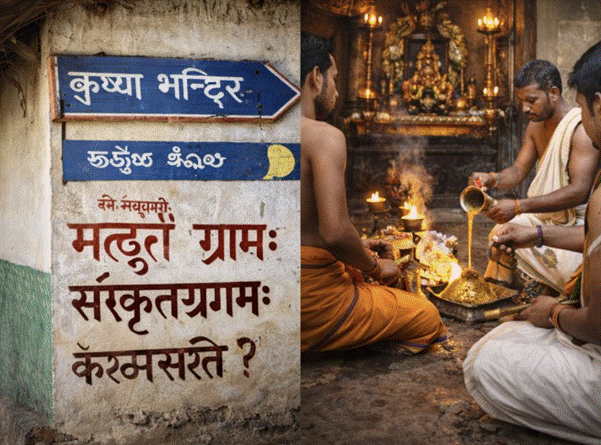
Sanskrit Speaking Village In India
Author : adminPublished : January 16, 2026
In an age dominated by global languages, instant messaging, and digital slang, the idea of an Indian village where people converse daily in Sanskrit seems almost improbable. Yet, in the state of Karnataka, Mattur has earned national and international recognition as “India’s Sanskrit-speaking village.” Unlike Sanskrit’s usual association with ritual, scripture, or classrooms, Mattur presents a rare example of the language being used as a living, spoken medium—for greetings, casual conversations, and community interaction.
Mattur’s reputation has drawn linguists, historians, journalists, students, and travellers from across the world. Media outlets frequently portray it as a linguistic anomaly—an ancient language surviving in modern daily life. However, what makes Mattur truly significant is not novelty alone, but the collective social effort that revived Sanskrit as a spoken language in the late twentieth century.
Equally important is Hosahalli, a neighbouring village located just across the Tunga River. Hosahalli shares the same cultural, linguistic, and educational tradition as Mattur and functions as its twin village in sustaining spoken Sanskrit. Together, Mattur and Hosahalli form a unique linguistic ecosystem—rooted in history, sustained by community choice, and adapted to modern life.
| population of Karnataka | literacy rate of Karnataka | sex ratio of Karnataka |
2. Where Are Mattur and Hosahalli?
Mattur and Hosahalli are located in Shivamogga district (formerly Shimoga) in central Karnataka. The villages lie approximately 15–20 kilometres from Shivamogga town, nestled along the banks of the Tunga River, a tributary of the Tungabhadra.
Geographic and Social Setting
- Region: Malnad belt of Karnataka
- Landscape: Fertile riverbanks, agricultural land, coconut and areca groves
- Population: A few thousand residents combined
The Tunga River plays both a physical and cultural role—supporting agriculture while also shaping settlement patterns and temple life. The villages are compact, socially cohesive, and well connected to nearby urban centres, enabling residents to engage with the wider world without losing their local identity.
Community Composition
The dominant community in both villages is the Sankethi Brahmin community, which migrated from Kerala roughly 600 years ago. Sankethis traditionally spoke Sanketi, a language influenced by Tamil, Kannada, and Malayalam. Over time, residents also became fluent in Kannada, the regional language.
Importantly, Sanskrit was not the original spoken language of the village. Its adoption was a conscious, later development—making Mattur and Hosahalli examples of language revival rather than language survival.
3. History of Sanskrit in the Village
Before the Revival
Until the late twentieth century, daily communication in Mattur and Hosahalli primarily occurred in Sanketi and Kannada. Sanskrit existed in the village as a liturgical and scholarly language, used in temples, rituals, and religious education—but not in ordinary conversation.
The Sanskrit Revival Movement (1980s)
The transformation began in the 1980s, when religious leaders, scholars, and local intellectuals raised concerns about Sanskrit becoming restricted to ritual use and losing its spoken vitality. Influential institutions—most notably the Pejawar Mutt (Pejawar Math) of Udupi—played a crucial role in encouraging the idea of a “Sanskrit-speaking village.”
Key elements of the revival included:
- Community-wide discussions on adopting Sanskrit for daily use
- Training sessions and conversational workshops
- Encouraging children to speak Sanskrit at home and school
- Public commitment by residents to practice spoken Sanskrit
Unlike imposed language policies, the revival in Mattur was voluntary and community-driven, which proved essential to its success.
Timeline of the Sanskrit Revival in Mattur (and Hosahalli)
This timeline traces how Mattur and its twin village Hosahalli transitioned from primarily Sanketi- and Kannada-speaking settlements into globally recognised centres of spoken Sanskrit, highlighting that this was a modern revival, not an unbroken ancient continuity.
c. 1400–1500 CE: Migration of the Sankethi Brahmins
The Sankethi Brahmin community migrates from present-day Kerala to the Tunga River region. They bring with them strong traditions of Vedic learning, ritual practice, and Sanskrit scholarship, though daily communication remains in Sanketi and Kannada.
Pre-20th Century: Sanskrit as Ritual and Scholarly Language
For several centuries, Sanskrit is used mainly for:
- Temple rituals
- Religious ceremonies
- Scriptural learning
It is respected as a sacred and scholarly language, but not spoken casually in everyday life.
Mid-20th Century (1950s–1970s): Growing Concern About Sanskrit’s Decline
Scholars and religious leaders across Karnataka and coastal regions express concern that Sanskrit is becoming confined to texts and rituals, losing its spoken vitality. Mattur’s strong educational culture makes it a potential site for revival.
Early 1980s: Call for a “Sanskrit-Speaking Village”
Influential religious institutions—most notably the Pejawar Mutt (Pejawar Math)—and Sanskrit scholars propose the idea of reviving Sanskrit as a spoken community language in Mattur and Hosahalli.
This marks the conceptual beginning of the revival.
1981–1985: Community Decision and Training Phase
Village elders, teachers, and families collectively agree to experiment with speaking Sanskrit in daily life.
Key steps include:
- Conversational Sanskrit training for residents
- Encouraging children to speak Sanskrit at home and school
- Voluntary commitment rather than enforcement
This phase is crucial because the revival is community-driven, not imposed.
Late 1980s–1990s: Sanskrit Enters Daily Conversation
Sanskrit begins to be used for:
- Greetings
- Informal street conversations
- Temple and community interactions
Residents continue using Kannada and Sanketi alongside Sanskrit, establishing a multilingual equilibrium rather than replacement.
1990s–Early 2000s: Institutionalisation Through Education
Sanskrit pathshalas, schools, and cultural programmes formalise the practice:
- Children receive early exposure to spoken Sanskrit
- Recitation and conversational practice become routine
- Festivals and public events increasingly use Sanskrit
This period ensures intergenerational continuity.
Early 2000s: National and International Media Attention
Mattur gains recognition through:
- Indian print and television media
- International coverage (including BBC features)
- Academic and linguistic interest
The village becomes popularly labelled as “India’s Sanskrit-speaking village.”
2010s: Adaptation to Modern Life
Residents increasingly pursue:
- Higher education
- IT and professional careers
- Urban employment
Despite migration and modern pressures, Sanskrit use remains a symbolic and practical cultural marker, especially during community gatherings.
2020s–Present: Sustaining Sanskrit in a Digital Era
Current efforts focus on:
- Digital Sanskrit learning tools
- Online content and social media engagement
- Cultural workshops and exchanges
The emphasis shifts from expansion to sustainability, ensuring Sanskrit remains relevant without isolating younger generations.
4. Sanskrit as a Living Daily Language
One of the most striking aspects of Mattur and Hosahalli is how naturally Sanskrit is integrated into daily life.
Everyday Usage
Sanskrit is used in:
- Morning greetings
- Conversations on village streets
- Interactions in shops and temples
- Community meetings and cultural events
Visitors may hear exchanges such as:
- “Katham asti?” (How are you?)
- “Aham gachchāmi.” (I am going.)
- “Bhavataḥ nāma kim?” (What is your name?)
Multilingual Reality
Despite popular portrayals, Sanskrit is not the only language spoken. Residents comfortably switch between:
- Sanskrit
- Sanketi
- Kannada
- Tamil (in some households)
- English (especially among professionals)
This multilingualism allows Sanskrit to function without displacing other languages, reinforcing the idea that language revival need not mean linguistic exclusivity.
Absolutely. Below is a carefully expanded and refined elaboration of Sections 5 and 6, written to add depth without repetition, strengthen E-E-A-T, and keep the tone grounded, respectful, and informative.
You can replace Sections 5 and 6 in your article with the versions below.
5. Education, Pathshalas, and Vedic Learning
Education is the central pillar sustaining Sanskrit as a living language in Mattur and Hosahalli. The continued use of Sanskrit in everyday conversation would not be possible without a strong, community-supported educational ecosystem that integrates classical learning with modern schooling.
Sanskrit Pathshalas and Traditional Learning
The villages are home to Sanskrit pathshalas where students receive rigorous training in:
- Vedic chanting and memorisation techniques
- Vyākaraṇa (Sanskrit grammar), ensuring linguistic accuracy
- Shāstric texts, including philosophy, ethics, and ritual manuals
These institutions follow traditional pedagogical methods such as oral transmission, repetition, and guided recitation, which help students internalise the language naturally rather than treat it as an abstract subject.
Integration With Modern Schooling
Importantly, Sanskrit education does not exist in isolation. Children in Mattur and Hosahalli attend regular schools where they study:
- Mathematics and sciences
- Social sciences
- Kannada, English, and sometimes Hindi
- Digital literacy and technology
Sanskrit functions as a complementary language, not a substitute. This balanced approach allows students to pursue higher education and professional careers while remaining rooted in their linguistic heritage.
Early Exposure and Community Reinforcement
Children are introduced to Sanskrit from a young age through:
- Daily conversations at home
- Community norms encouraging Sanskrit during festivals and meetings
- Public recitation and storytelling
Because Sanskrit is spoken by adults in everyday contexts, children acquire it as a natural spoken language, not merely as a classroom subject. This intergenerational reinforcement is key to the village’s success.
6. Culture, Traditions, and Arts

Beyond formal education, cultural practice plays a crucial role in keeping Sanskrit alive in Mattur and Hosahalli. Language here is embedded in ritual, performance, and shared community experience, making it visible, audible, and emotionally resonant.
Ritual Life and Festivals
Temples serve as cultural centres where:
- Daily rituals are conducted with Sanskrit chants
- Festivals involve communal recitation and hymns
- Ceremonies mark life events such as births, marriages, and rites of passage
These rituals ensure that Sanskrit is not confined to textbooks but is performed collectively, reinforcing fluency and familiarity.
Performing Arts and Oral Traditions
Traditional art forms contribute significantly to language preservation:
- Gamaka, a narrative art combining storytelling, music, and explanation, allows complex Sanskrit texts to be interpreted for broader audiences.
- Classical music and Vedic recitation develop pronunciation, rhythm, and memory.
- Public discourses and cultural gatherings encourage spontaneous Sanskrit speech.
Hosahalli, in particular, is recognised for its strong tradition in music and oral performance, complementing Mattur’s educational emphasis.
Cultural Continuity in a Modern Context
What distinguishes Mattur–Hosahalli is not cultural rigidity, but adaptability. Sanskrit is used alongside modern forms of expression:
- Cultural events coexist with contemporary festivals
- Traditional performances are sometimes recorded and shared digitally
- Young residents engage with Sanskrit through both classical and modern mediums
This flexibility prevents Sanskrit from becoming a static symbol of the past and allows it to remain relevant and accessible.
Why These Sections Matter
Together, education and culture create a self-reinforcing system:
- Schools and pathshalas provide structure and continuity
- Rituals and arts provide emotional connection and daily exposure
- Community participation ensures sustainability
Mattur and Hosahalli demonstrate that language revival succeeds not through compulsion or nostalgia, but through education, cultural integration, and collective choice.
7. Economy and Modern Life in a Sanskrit Village
Contrary to stereotypes, Mattur and Hosahalli are not isolated or economically stagnant.
Occupations
Residents engage in:
- Agriculture (paddy, areca nut, coconut)
- Temple and educational work
- Teaching and scholarship
- IT, engineering, and professional careers
Many villagers work in cities like Bengaluru while maintaining strong ties to the village.
Balancing Tradition and Modernity
Smartphones, internet access, and modern appliances are common. Sanskrit use does not conflict with technology; rather, residents demonstrate that traditional language and modern careers can coexist.
8. Other Sanskrit-Promoting Villages in India
Mattur is not alone. Other villages such as Jhiri (Madhya Pradesh), Sasana (Odisha), and Baghuwar (Madhya Pradesh) promote Sanskrit education and usage.
However, Mattur–Hosahalli stands out because:
- Sanskrit is used consistently in daily conversation
- The revival is community-wide, not limited to schools
- The practice has been sustained for decades
These villages together form a broader Sanskrit revival landscape in India.
9. Challenges, Myths, and the Future of Sanskrit Here
Challenges
- Youth migration to cities
- Time constraints of modern education and jobs
- Perception of Sanskrit as elitist or exclusionary
Common Myths
- That Sanskrit is spoken only by Brahmins
- That it is impractical for modern life
- That it replaces regional languages
In reality, Mattur demonstrates inclusion, adaptability, and coexistence.
The Road Ahead
Villagers are exploring:
- Digital Sanskrit content
- Online learning initiatives
- Cultural exchanges and workshops
The future of Sanskrit in Mattur depends not on nostalgia, but on continued relevance and choice.
Conclusion
Mattur and Hosahalli challenge deeply held assumptions about language, tradition, and modernity. They show that Sanskrit need not remain confined to texts and temples—it can live, breathe, and adapt within contemporary society.
Rather than a relic of the past, Sanskrit in Mattur is a social experiment in cultural continuity, sustained by community will, education, and everyday practice. In doing so, these villages offer India—and the world—a rare example of how ancient languages can survive not by preservation alone, but by participation.
Latest Post
 City Of Peace In India
9/14/2026
 Highest Tax Paying City In India
9/13/2026
 City Of Light In India
9/12/2026
 City Of Hills In India
9/11/2026
 City of Gods in India
9/10/2026