Oldest village in world
Author : adminPublished : March 30, 2026
Long before streets, cities, kings, or written language existed, human beings made a radical decision: to stay in one place permanently. On the flat expanse of Turkey’s Konya Plain, that decision materialised as Çatalhöyük, the world’s oldest known large-scale village and humanity’s first true experiment in sedentary, communal living.
Dating from approximately 7400 BCE to 6200 BCE, Çatalhöyük was not a campsite or a seasonal settlement. It was a dense, permanent community that housed 5,000 to 10,000 people—a staggering number for the Neolithic world. The settlement grew continuously for more than 1,200 years, layering house upon house until the East Mound rose over 21 metres high, preserving 18 distinct occupational levels like pages in a human diary.
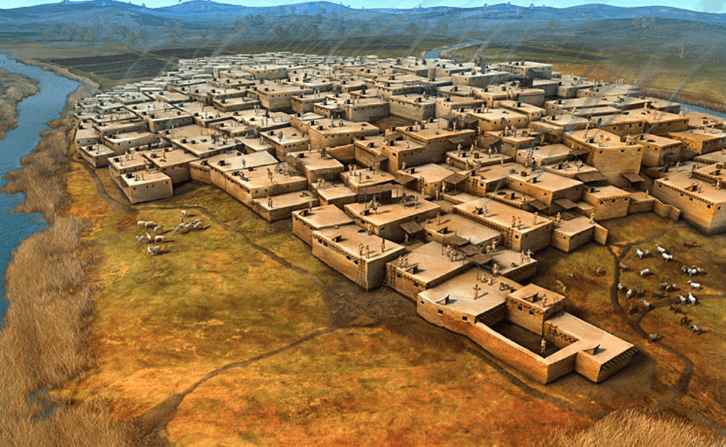
What makes Çatalhöyük extraordinary is not just its age, but its urban logic without cities. There were no streets, no palaces, no temples, no fortifications, and no rulers. Houses were packed wall-to-wall, entered from the roof, and organised around shared cultural practices rather than hierarchy. Farming, animal domestication, art, ritual, and trade all coexisted within a radically egalitarian social framework.
Unlike Göbekli Tepe, which was ritual without settlement, or Jericho, which was settlement without density, Çatalhöyük represents the missing bridge: a place where agriculture, permanent housing, symbolism, and social organisation fused into something recognisably urban—without becoming a city.
In the story of villages, Çatalhöyük is the temporal extreme: the origin point from which all later villages, towns, and cities ultimately descend.
2. Location Deep Dive: The Konya Plain and the Birthplace of Sedentary Life

Çatalhöyük sits in the heart of Central Anatolia, on the southern edge of Turkey’s vast Konya Plain—one of the most agriculturally productive landscapes in the ancient world. This location was not accidental; it was a perfect ecological convergence zone.
Geographic Advantages
The settlement lies near ancient marshlands fed by seasonal rivers, providing:
- Reliable freshwater
- Fish and waterfowl
- Fertile alluvial soils
- Reed beds for construction materials
Surrounding grasslands supported wild cattle (aurochs), sheep, and goats, while nearby hills offered access to obsidian, the Neolithic world’s most valuable trade material.
| Geographic Feature | Contribution to Settlement |
| Marshlands | Water, fish, reeds |
| Alluvial soil | Wheat and barley cultivation |
| Migration routes | Wild cattle domestication |
| Obsidian sources | Long-distance trade |
Strategic Isolation Without Isolation
Although inland, Çatalhöyük was not isolated. Obsidian from Cappadocia (150 km away) reached the site in large quantities, proving the village was embedded in regional trade networks. Shells from the Mediterranean and pigments from distant sources further confirm its connectivity.
The Konya Plain allowed Çatalhöyük to grow large without competition—no nearby rival settlements existed at comparable scale. This ecological monopoly enabled sustained population growth and social experimentation.
3. Stratigraphic Architecture: 18 Layers of Human Life
Çatalhöyük is not one village—it is 18 villages stacked vertically, each built directly on the remains of the previous one. This stratigraphic depth makes it one of the most information-rich archaeological sites on Earth.
Chronological Layers
| Layer Group | Approx. Dates (BCE) | Key Characteristics |
| XVIII–XIV | 7400–7100 | First mudbrick houses |
| XIII–X | 7100–6500 | Dense housing, farming |
| IX–VI | 6500–6000 | Population peak |
| V–I | 6000–5600 | Gradual decline |
Each time a house became uninhabitable, it was carefully cleaned, ritually closed, and rebuilt, creating a vertical record of domestic life rather than destruction.
Vertical Urbanism
By Level VI (around 6500 BCE), population density reached roughly one house per 40 square metres, making Çatalhöyük more crowded than many medieval towns. This extreme density was managed without streets, relying instead on rooftops as communal pathways.
Equally remarkable are the burials—over 500 skeletons discovered beneath house floors. Homes functioned as living spaces, burial chambers, and ritual centres simultaneously, reinforcing powerful ancestral ties.
Çatalhöyük is thus the world’s first vertically layered community, a prototype for later urban stratification.
4. Housing Innovation: The Streetless Mudbrick Cluster

Çatalhöyük’s houses represent one of the most radical architectural experiments in human history.
Standardised House Design
Despite spanning over a millennium, house sizes remained remarkably consistent:
| Feature | Specification |
| Average size | 25–30 m² |
| Wall thickness | ~60 cm |
| Construction | Sun-dried mudbrick |
| Entry | Roof ladder |
| Rooms | 1 main + 1 storage |
This standardisation suggests social equality—no elite housing, no palaces, no slums.
No Streets, No Doors
There were no doors at ground level. Entry occurred through a hole in the roof, usually above the hearth. Rooftops functioned as:
- Streets
- Workspaces
- Drying platforms
- Social areas
This design enhanced security, hygiene, and thermal regulation while reinforcing communal interaction.
Houses as Life Cycles
Each house was:
- Lived in
- Decorated with art
- Used for rituals
- Used for burial
- Sealed and rebuilt
Architecture at Çatalhöyük was not just shelter—it was identity, memory, and cosmology combined.
5. Agricultural Revolution: The First Farming Economy
Çatalhöyük marks one of the earliest moments when agriculture became the primary basis of human life.
Crop Domestication
Archaeobotanical evidence reveals systematic farming of:
| Crop | Evidence |
| Einkorn wheat | Carbonised grains |
| Emmer wheat | Grinding residues |
| Barley | Fermentation vessels |
| Lentils & peas | Storage pits |
Stone sickles, querns, and grinding stones indicate year-round grain processing, not seasonal gathering.
Animal Domestication
Domestication followed a phased pattern:
- Sheep and goats first
- Cattle later (around 7000 BCE)
The domestication of aurochs into cattle was especially significant—it provided meat, hides, traction, and symbolic power.
Food surpluses enabled:
- Population growth
- Craft specialisation
- Long-term settlement
Agriculture at Çatalhöyük was not experimental—it was systemic, reliable, and scalable.
6. Artistic Explosion: The World’s Oldest Murals
Çatalhöyük contains the earliest known large-scale wall paintings in human history, turning ordinary houses into artistic spaces.
Wall Paintings
Key motifs include:
- Hunting scenes
- Geometric patterns
- Vultures and headless humans
- A volcanic eruption of Hasan Dağ—the world’s oldest known landscape painting
These murals were repeatedly replastered and repainted, suggesting ongoing artistic traditions, not isolated events.
Sculptural Art
More than 150 figurines have been found, most famously the Seated Woman flanked by leopards, often interpreted as a fertility or nature deity.
Art at Çatalhöyük was:
- Domestic (inside homes)
- Symbolic
- Communal
- Repetitive across generations
This was not decoration—it was meaning-making.
7. Religion and Ritual: Skull Cults and Ancestor Worship
Religion at Çatalhöyük was deeply integrated into daily life.
Burial Practices
Most individuals were buried beneath house floors, often in a flexed position. In many cases:
- Skulls were later removed
- Plastered
- Displayed on benches or walls
This indicates a strong ancestor cult, where the dead remained present among the living.
Ritual Architecture
Some houses functioned as shrines, identifiable by:
- Bull horns mounted on walls
- Red ochre floors
- Concentrations of figurines
- Repeated ritual repainting
There were no central temples. Religion was decentralised, household-based, and collective.
Belief at Çatalhöyük did not separate sacred and secular—it fused them, creating social cohesion without authority.
8. Trade Networks: Çatalhöyük as a Neolithic Exchange Hub
Despite lacking wheeled transport, written language, or coinage, Çatalhöyük functioned as a regional trade powerhouse in the Neolithic world. Its economic reach extended hundreds of kilometres beyond the Konya Plain, demonstrating that long-distance exchange predates cities and states.
Obsidian: The Black Gold of the Neolithic
The most important traded material at Çatalhöyük was obsidian, a volcanic glass prized for its sharpness and symbolic value.
| Trade Material | Source | Distance | Archaeological Evidence |
| Obsidian | Cappadocia | ~150 km | Tens of tons across all levels |
| Marine shells | Mediterranean | ~300 km | Beads and pendants |
| Copper | Anatolian uplands | ~200 km | Early smelting residues |
| Flint | Local | <50 km | Arrowheads, sickles |
Obsidian tools are found in nearly every household, indicating universal access, not elite control. This reinforces the interpretation of Çatalhöyük as a non-hierarchical trade society.
Craft Specialisation Without Classes
Evidence suggests specialised craftspeople:
- Bead makers (lapidary workshops)
- Potters (later levels)
- Metal experimenters (early copper work)
Yet these specialists lived in standard-sized houses, ate similar diets, and were buried without status distinction. Trade at Çatalhöyük supported collective prosperity, not inequality.
Çatalhöyük proves that complex economies can exist without markets, money, or rulers.
9. Social Structure: An Egalitarian Proto-City
One of Çatalhöyük’s most revolutionary aspects is what it lacks: kings, temples, palaces, elites, or slums. Archaeologically, it represents the most convincing example of prehistoric social equality ever discovered.
Evidence of Equality
| Social Marker | Observation |
| House size | Uniform across settlement |
| Burial goods | Minimal variation |
| Diet | Equal nutrition across genders |
| Art access | Murals in ordinary homes |
| Tools | Even obsidian distribution |
There is no spatial segregation, no “rich quarter,” and no monumental architecture indicating power concentration.
Gender Balance
Bioarchaeological analysis reveals:
- Similar workloads for men and women
- Comparable nutrition and health
- Shared roles in hunting imagery
- Prominence of female figurines
Rather than matriarchal or patriarchal, Çatalhöyük appears gender-balanced, organised around households rather than authority.
This social model—dense, cooperative, and decentralised—makes Çatalhöyük the earliest known experiment in large-scale egalitarian living.
10. Decline and Abandonment: The End of the First Village
After thriving for over a millennium, Çatalhöyük began a gradual, peaceful decline—one of the most intriguing puzzles in archaeology.
Timeline of Decline
| Period | Indicator |
| ~6500 BCE | Population peak |
| ~6400 BCE | Reduced rebuilding |
| ~6200 BCE | East Mound abandonment |
| ~6000 BCE | Shift to West Mound |
There is no evidence of war, invasion, fire, or sudden collapse.
Leading Theories
- Environmental Stress
Continuous farming exhausted soils; climate records indicate regional aridification around 6200 BCE. - Resource Pressure
Overhunting and fuel demands strained the ecosystem. - Social Reorganisation
Smaller, more dispersed settlements replaced dense living.
Rather than collapsing, Çatalhöyük evolved out of existence, its population dispersing into new village forms.
This marks the end of humanity’s first urban experiment—not in failure, but in transformation.
11. Excavation History: From Mellaart to Hodder
Çatalhöyük’s modern story is almost as remarkable as its ancient one.
Discovery and Early Excavation
- 1961–1965: British archaeologist James Mellaart uncovered murals, figurines, and dense housing, shocking the archaeological world.
- His interpretations placed Çatalhöyük at the centre of Neolithic studies, though controversy followed.
The Hodder Revolution
From 1993 to 2023, archaeologist Ian Hodder led one of the most comprehensive archaeological projects ever undertaken:
- Multi-disciplinary teams (DNA, isotopes, micro-archaeology)
- Transparent data publication
- Social theory applied to prehistory
Hodder’s work confirmed many early findings while grounding them in scientific rigour, making Çatalhöyük one of the best-documented prehistoric sites on Earth.
12. UNESCO Significance: The Neolithic Rosetta Stone
In 2012, Çatalhöyük was inscribed as a UNESCO World Heritage Site, recognising its unparalleled contribution to human history.
Why UNESCO Matters
Çatalhöyük meets Criterion (iii):
“A unique testimony to a cultural tradition or civilisation.”
It preserves:
- The earliest large-scale village life
- Complete Neolithic social systems
- Continuous architectural evolution
- Symbolic worldviews frozen in time
Global Benchmarking
| Site | Date (BCE) | Urban Features |
| Göbekli Tepe | 9500 | Ritual only |
| Jericho | 9000 | Walls, hierarchy |
| Çatalhöyük | 7400 | Dense egalitarian proto-city |
Çatalhöyük stands alone as the most complete picture of early village civilisation.
13. Visiting Çatalhöyük: A Neolithic Time Machine
Today, Çatalhöyük is a carefully preserved archaeological park offering visitors a rare opportunity to walk through humanity’s origins.
Visitor Experience
- Location: 45 minutes from Konya
- Entry: €10–12
- Duration: 2–3 hours
Highlights include:
- Protected excavation shelters
- Reconstructed Neolithic houses
- Interactive visitor centre
- Original wall painting displays
Standing atop the mound, visitors can see 9,000 years of human decisions beneath their feet.
This is not tourism—it is deep time travel.
14. Conclusion: Civilization’s Ground Zero
Çatalhöyük is not merely the world’s oldest village—it is the foundation of human society as we know it.
Here, humanity:
- Chose permanence over mobility
- Replaced hunting with farming
- Built dense communities without rulers
- Created art before writing
- Practised religion without temples
- Traded without markets
For over 1,200 years, up to 10,000 people lived together without hierarchy, proving that cooperation—not domination—was humanity’s first urban strategy.
In the story of villages, Çatalhöyük is the temporal extreme—the origin point from which all later rural and urban life descends.
Every village that exists today, anywhere in the world, is—at some level—a descendant of this extraordinary Neolithic experiment.
Latest Post
 Greenest City in India
9/24/2026
 Vegetarian City in India
9/23/2026
 Floating City in India: Srinagar
9/22/2026
 Dry City in India
9/21/2026
 Pink City of India
9/20/2026