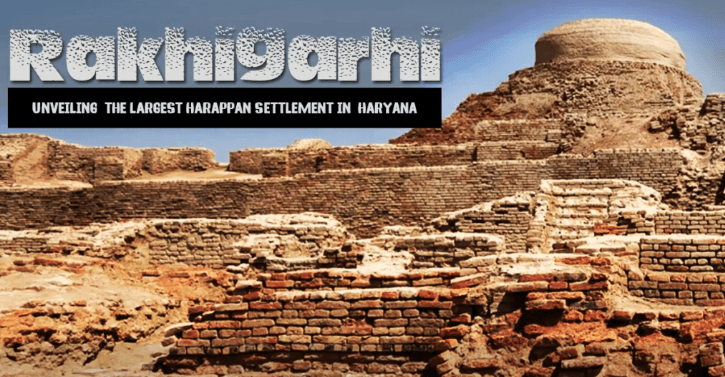
Oldest village in India
Author : adminPublished : March 31, 2026
In the fields of Rakhi Khas and Rakhi Shahpur, farmers move through ripening wheat and mustard crops, guiding cattle along dusty village paths much as their ancestors did generations ago. Children play in narrow lanes flanked by old havelis, while elders gather outside small shops discussing harvests, politics, and the weather. At first glance, Rakhigarhi looks like many other villages of northern India. Yet beneath these everyday rhythms lies something extraordinary: the buried remains of one of the largest and oldest cities of the Indus Valley (Harappan) Civilization, dating back more than 4,500–5,000 years.
Located in Hisar district of Haryana, Rakhigarhi is not merely an archaeological site surrounded by emptiness. It is a living village complex physically overlapping with an ancient urban centre. Modern houses, lanes, and fields sit directly atop Harappan streets, drainage systems, houses, workshops, and burial grounds. This rare overlap has led historians and archaeologists to describe Rakhigarhi as one of India’s oldest continuously inhabited village locales—a place where human settlement has persisted, in different forms, from the Bronze Age to the present day.
Rakhigarhi is also India’s largest known Harappan site, covering roughly 224 to over 300 hectares, surpassing even Harappa and Mohenjo-daro in spatial extent. Excavations have revealed evidence from the Early, Mature, and Late Harappan phases, making it a crucial reference point for understanding the rise, peak, and transformation of one of the world’s earliest urban civilizations.
This article explores Rakhigarhi in detail—its geography, its Harappan past, its modern village life, groundbreaking DNA research, conservation challenges, and the careful reasoning behind its claim as one of India’s oldest villages. Throughout, the discussion relies on ASI reports, academic research, government documentation, and reputable journalism, while remaining honest about scholarly debates and uncertainties.
| population of Haryana | literacy rate of Haryana | sex ratio of Haryana |
2. Where Is Rakhigarhi and What Is the Present-Day Village Like?
2.1 Location and physical setting
Rakhigarhi lies in Hisar district, Haryana, approximately 150 kilometres northwest of Delhi, in the fertile plains associated with the ancient Ghaggar–Drishadvati river system. Though the Ghaggar is largely seasonal today, geological and archaeological evidence suggests that during the Harappan period it was part of a much more active river network that supported dense settlement and agriculture.
The site consists of nine major archaeological mounds, scattered around and beneath the modern villages of Rakhi Shahpur and Rakhi Khas. These mounds—labelled by archaeologists for excavation purposes—represent different neighbourhoods of the ancient city: residential areas, industrial zones, burial grounds, and possibly administrative or public spaces.
2.2 Present-day village life
Today, Rakhigarhi functions primarily as an agricultural village. Wheat, mustard, fodder crops, and dairy farming—especially buffalo rearing—form the backbone of the local economy. Houses range from centuries-old havelis built of brick and lime to more recent concrete structures. Narrow lanes, courtyards, and shared walls echo patterns of dense habitation that, coincidentally, mirror the ancient city below.
The population is modest by rural standards, but the sense of living amid history is palpable. Excavation trenches lie just beyond cultivated fields. In some places, ancient bricks and pottery shards are still turned up during ploughing, reminding villagers that their land carries a much older story.
2.3 Connectivity and access
Rakhigarhi is accessible by road from Hisar city, which itself is well connected to Delhi and other major towns of Haryana. Tourism infrastructure remains basic, though the Government of India and Haryana authorities have announced plans for an on-site museum and visitor facilities as part of a national “iconic sites” initiative. For now, the village balances quiet rural life with periodic visits from archaeologists, students, and heritage enthusiasts.
3. Harappan Rakhigarhi: Scale, Layout and Dating
3.1 Size and importance

Among all Indus Valley Civilization sites discovered so far, Rakhigarhi is the largest in India and possibly the largest overall by area. Estimates range from 224 hectares to over 300 hectares, depending on how peripheral mounds are counted. This scale indicates that Rakhigarhi was not a minor town but a major urban centre, comparable in importance to Harappa and Mohenjo-daro.
Archaeological evidence shows that Rakhigarhi was integrated into the wider Harappan world through trade, shared technologies, and cultural practices, while also displaying regional adaptations unique to the Ghaggar plains.
3.2 Chronology and phases
Excavations reveal occupation across all major Harappan phases:
- Early Harappan (c. 3500–2600 BCE): formative settlement, early brick architecture, and evolving craft traditions.
- Mature Harappan (c. 2600–1900/1800 BCE): peak urban planning, standardized bricks, drainage systems, and extensive craft production.
- Late Harappan (post-1900 BCE): gradual transformation, changes in material culture, and possible decentralisation rather than sudden collapse.
Recent studies and news reports have suggested that some layers at Rakhigarhi may push the origins of Harappan culture back 7,000–8,000 years, though these claims are still under scholarly evaluation.
3.3 Urban planning and infrastructure
Rakhigarhi displays hallmark features of Harappan urbanism: paved roads, grid-like layouts, standardized baked bricks, covered drains, rainwater management, and clearly demarcated residential and industrial zones. Workshops for bead-making, pottery, and metalworking indicate economic specialization and long-distance trade networks.
4. The Modern Village Sitting on an Ancient City
4.1 A village literally built on history
Rakhigarhi is one of the very few places in the world where a living rural settlement physically overlaps with a major Bronze Age city. In the villages of Rakhi Khas and Rakhi Shahpur, everyday life unfolds directly atop Harappan remains that date back more than 4,500–5,000 years. Narrow village lanes follow the contours of ancient streets; courtyards and houses rest on layers of baked brick walls, drainage channels, and floors laid by Harappan builders.
Two of the most important archaeological mounds—commonly referred to as Mound 4 and Mound 5—are still densely inhabited. For generations, villagers unknowingly used ancient bricks for construction or found pottery shards while digging foundations or ploughing fields, unaware of their archaeological significance. This continuity was not intentional preservation but a natural outcome of uninterrupted human settlement in a fertile region.
4.2 Daily life amid excavations
Today, Rakhigarhi presents a striking contrast: agricultural fields stretch alongside fenced excavation trenches, and archaeologists work within sight of grazing buffaloes and village homes. The rhythm of rural life—milking cattle, tending crops, visiting local shrines—coexists with scientific research and occasional tourist visits.
Local awareness of the site’s importance has grown significantly in recent decades. Many villagers express pride that their home is linked to the Indus Valley Civilization, often described as one of the world’s earliest urban cultures. At the same time, there is anxiety and fatigue caused by construction restrictions, land-use regulations, and uncertainty about compensation or relocation in protected zones.
4.3 Conservation, law, and lived reality
The overlap of habitation and archaeology has inevitably produced tension. The Archaeological Survey of India (ASI) is tasked with protecting the site, while villagers must maintain livelihoods and housing. Legal disputes culminated in a 2009 Punjab & Haryana High Court order directing the removal of encroachments from protected mounds. While necessary for preservation, such measures created social stress and resistance.
Increasingly, heritage experts advocate a “living heritage village” approach, arguing that conservation should integrate residents as stakeholders. This model emphasises community participation, heritage-linked employment, and infrastructure development—ensuring that preservation does not come at the cost of human dignity or economic survival.
5. What Excavations Reveal: Houses, Crafts and Daily Life
5.1 Urban housing and neighbourhood planning

Excavations at Rakhigarhi reveal a highly organised urban environment. Harappan houses were typically multi-room structures with courtyards, kitchens, hearths, and storage areas. Some homes contained two to six rooms, indicating varied household sizes and possibly extended family units. Walls were built using standardized baked bricks, reflecting advanced construction norms and central planning.
Drainage systems are among the most impressive features. Covered drains ran alongside streets and houses, carrying wastewater away efficiently—evidence of a civic concern for hygiene rarely matched in contemporaneous civilizations. Rainwater harvesting and wells suggest careful water management in a semi-arid environment.
5.2 Crafts, industry and economic life
Rakhigarhi was a major craft and industrial hub within the Harappan world. Archaeologists have uncovered workshops dedicated to:
- Bead-making using carnelian, agate, and faience
- Copper and bronze metallurgy
- Pottery production with fine and coarse wares
- Shell and terracotta ornament manufacture
Finished products from Rakhigarhi likely travelled along trade networks connecting the Ghaggar plains to Gujarat, Rajasthan, and beyond. Standardised weights and seals found at the site suggest regulated trade and economic integration across the Indus system.
5.3 Food systems and environmental adaptation
Zooarchaeological remains show heavy reliance on cattle and buffalo, along with sheep and goats. This aligns closely with modern pastoral practices in the region, reinforcing a sense of environmental continuity. Botanical remains confirm cultivation of cereals and pulses, while fish hooks and net weights indicate river-based subsistence during periods when the Ghaggar was active.
Together, these findings portray a society that was economically diverse, environmentally adaptive, and technologically advanced, capable of sustaining a large urban population for centuries.
6. Human Remains, DNA and the Question of Continuity
6.1 Burial practices and social insight
Burials at Rakhigarhi offer rare glimpses into Harappan social life. Graves include extended and flexed burials, sometimes brick-lined, accompanied by pottery, beads, and ornaments. The relatively even distribution of grave goods suggests limited social stratification, reinforcing the idea that Harappan society may have been more egalitarian than later urban cultures.
Skeletal analysis indicates physically demanding lives, with evidence of joint stress, dental wear, and healed injuries—markers of agricultural labour and dense living conditions.
6.2 Ancient DNA: a landmark discovery
One of the most transformative discoveries at Rakhigarhi was the successful extraction and sequencing of ancient DNA from a Harappan burial—a first for the Indus Valley Civilization. Genetic analysis indicated strong continuity with later South Asian populations and minimal steppe ancestry, challenging long-standing assumptions about large-scale migrations replacing Harappan peoples.
This finding repositioned the Harappans as genetically foundational to later populations in the subcontinent, rather than a vanished or replaced group.
6.3 Understanding continuity responsibly
Continuity does not mean unbroken lineage or cultural stasis. Over millennia, populations mixed, languages changed, and social systems evolved. The modern villagers of Rakhigarhi are not direct replicas of Harappans, but they occupy the same geographic and ecological niche, inheriting land-use patterns shaped thousands of years earlier.
This layered continuity—genetic, environmental, and cultural—supports describing Rakhigarhi as a continuously inhabited settlement zone, while avoiding simplistic or nationalist interpretations.
7. Is Rakhigarhi Really India’s “Oldest Village”?
7.1 Defining “oldest village”
The claim depends on definition. Rakhigarhi is:
- One of the oldest archaeological urban sites in India.
- A place where human settlement has persisted in the same location from the Harappan period to today.
This combination is rare.
7.2 Comparison with other claims
Varanasi is often cited as India’s oldest continuously inhabited city, while villages like Malana claim ancient traditions without deep archaeological layers. Rakhigarhi stands out because its claim rests on stratified archaeological evidence plus modern habitation.
7.3 Responsible phrasing
The most accurate description is:
“Rakhigarhi in Haryana is one of India’s oldest known continuously inhabited village sites, built directly above a major Harappan city dating back over 4,500–5,000 years.”
8. Heritage, Museum Plans and the Village’s Future
8.1 Rakhigarhi as an iconic heritage site
Recognising its global importance, the Government of India has designated Rakhigarhi as one of five “iconic archaeological sites” slated for focused development. Plans include a world-class on-site museum, interpretation centres, digital reconstructions, and visitor amenities designed to showcase Harappan life and discoveries.
The proposed museum aims to display artefacts, explain excavation methods, and contextualise Rakhigarhi within the Indus Valley Civilization—making complex archaeology accessible to the public.
8.2 Balancing conservation and livelihoods
The central challenge remains balancing heritage protection with villagers’ rights and needs. Excavations require land access; preservation restricts construction; tourism brings opportunity but also disruption. Without inclusive planning, heritage risks becoming a burden rather than a benefit.
Experts increasingly argue that villagers should be partners in preservation—employed as guides, custodians, artisans, and service providers. Infrastructure improvements, educational facilities, and revenue-sharing models can transform heritage into a sustainable local asset.
8.3 Role of researchers, students and visitors
Rakhigarhi continues to serve as a major training ground for archaeologists, with involvement from ASI, Deccan College, and international universities. Field schools, surveys, and scientific studies contribute to global understanding of early urbanism.
Visitors, too, play a role. Responsible engagement—respecting boundaries, supporting local initiatives, and approaching the site as a living community rather than a static ruin—helps ensure that Rakhigarhi’s future honours both its ancient past and its present residents.
9. Conclusion: A Village That Carries 5,000 Years of Memory
Rakhigarhi is not just an archaeological ruin nor merely a modern village. It is a palimpsest of human history, where layers of life—from Bronze Age urban planners to contemporary farmers—coexist in the same landscape. While scholars rightly avoid declaring a single “oldest village,” Rakhigarhi remains one of the best-documented examples of continuous human habitation in India.
Its significance lies not only in its age, but in what it teaches us: that human settlements are not static, that civilizations transform rather than vanish, and that the present is always built—literally and culturally—upon the foundations of the past.
Latest Post
 Greenest City in India
9/24/2026
 Vegetarian City in India
9/23/2026
 Floating City in India
9/22/2026
 Dry City in India
9/21/2026
 Pink City of India
9/20/2026