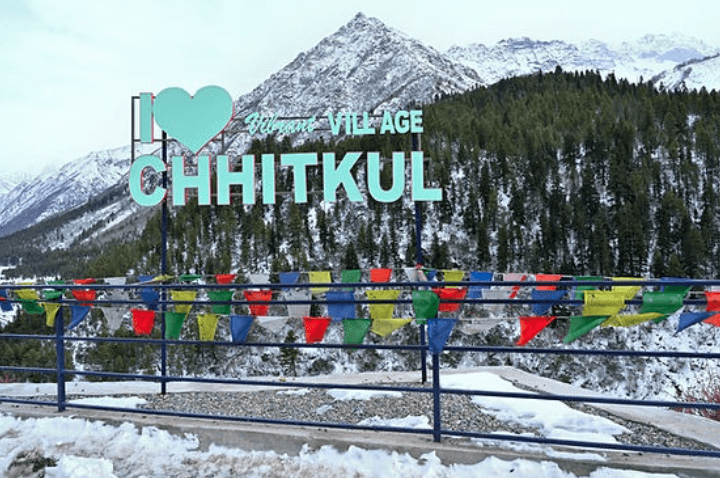
Last village in India
Author : adminPublished : April 6, 2026
At an altitude of 11,320 feet (3,450 metres), tucked deep within the Baspa Valley of Kinnaur district, lies Chitkul—a village that exists not merely on the map of India, but at the very edge of its civilian geography. Beyond this point, roads thin out, permits become mandatory, and military oversight replaces everyday life. Chitkul is widely recognised as India’s last inhabited civilian village on the western Himalayan frontier, the final stop before the restricted Indo-Tibetan border zone begins.
Home to roughly 600 residents across 120 households, Chitkul endures conditions that test the limits of human settlement. For nearly six months every year, from December to May, the village is locked under heavy snow, cut off from the rest of the country. Roads close, electricity becomes unreliable, and most residents migrate temporarily to lower altitudes. When winter peaks, Chitkul transforms into a near-ghost village—silent, snowbound, and inaccessible.
Yet Chitkul is far from fragile. It is globally known for producing one of the world’s most expensive potatoes, cultivated at extreme altitude and prized for its taste and density. Scientific studies have also identified Chitkul as having some of the cleanest ambient air in India, free from industrial pollution and urban particulates. Its people live in centuries-old wooden tower houses, engineered to withstand avalanches, earthquakes, and prolonged sub-zero temperatures.
Chitkul is not simply “remote.” It is terminal—the last point where civilian India breathes freely before borders harden. As such, it represents the geographical extreme of your villages series: a settlement where climate, altitude, geopolitics, and culture converge, producing one of the most resilient human communities in the subcontinent.
| population of Himachal Pradesh | literacy rate of Himachal Pradesh | sex ratio of Himachal Pradesh |
2. Location Deep Dive: Baspa Valley Terminus
Chitkul occupies a strategic and symbolic location at the uppermost end of the Baspa Valley, a tributary valley of the Sutlej River system. Administratively, it falls under Kinnaur district in Himachal Pradesh, one of India’s most sparsely populated and strategically sensitive Himalayan regions.
Terminal Geography
| Parameter | Specification |
| State | Himachal Pradesh |
| District | Kinnaur |
| Coordinates | 31°21′07″N, 78°26′13″E |
| Elevation | 3,450 metres (11,320 ft) |
| Distance from Shimla | ~455 km |
| Distance from Sangla | 22 km |
| Road Status | Final civilian road on Hindustan-Tibet route |
The village marks the end of the historic Hindustan-Tibet trade route, once used by traders transporting salt, wool, and grains between India and Tibet. Beyond Chitkul, roads are maintained exclusively by the Border Roads Organisation (BRO) and serve military logistics rather than civilian travel.
Importantly, Chitkul is one of the very few frontier villages in India that does not require an Inner Line Permit for civilian visitors, making it uniquely accessible despite its proximity to sensitive border zones.
Geographically, the Baspa River acts as both a life source and a natural boundary, carving through glacial terrain and sustaining agriculture during the short summer season. Towering above the village are the peaks of the Kinnaur Kailash range, rising beyond 6,000 metres and forming a dramatic alpine enclosure.
Chitkul’s location is not accidental—it is the absolute limit of viable civilian habitation along this valley.
3. Seasonal Migration: The Six-Month Ghost Village

Life in Chitkul is defined by a binary seasonal rhythm—one half bustling and productive, the other silent and abandoned.
Annual Occupation Cycle
| Period | Status | Population |
| June – November | Fully inhabited | ~600 |
| December – January | Partial evacuation | ~50 |
| February – May | Complete abandonment | 0 |
By late November, snowfall intensifies rapidly. Accumulations often exceed 4–6 metres, making roads impassable and collapsing communication networks. By December, nearly the entire population migrates to Sangla, Reckong Peo, or Rampur, located 1,500–2,000 metres lower in elevation.
This is not distress migration—it is institutionalised seasonal adaptation, practiced for generations.
Migration Logistics
Before leaving:
- Food grains and potatoes are sealed in underground kothars
- Homes are reinforced and sealed against snow pressure
- Livestock is moved to lower pastures
- Religious closure rituals are performed at the Nagasti Temple
During winter, only a small contingent of essential personnel remains—typically BRO monitors, temple caretakers, and communication staff—before the village becomes fully vacant.
Chitkul’s survival depends not on resisting winter, but on temporarily surrendering to it.
4. Architectural Marvel: Anti-Avalanche Kinnauri Towers
Chitkul’s most striking feature is its traditional Kinnauri tower houses, structures that represent one of the most sophisticated examples of vernacular Himalayan architecture.
Structural Specifications
| Feature | Design Logic |
| Height | 3–4 storeys (12–15 m) |
| Base | Sloped stone foundation |
| Frame | Deodar wood beams |
| Roof | Heavy slate slabs |
| Windows | Minimal, upper levels only |
| Ground Floor | Livestock shelter |
These houses are engineered to deflect avalanches, absorb seismic shocks, and retain heat during prolonged sub-zero conditions. Thick stone bases resist snow pressure, while wooden upper structures flex during earthquakes—an architecture perfected through centuries of trial.
Passive Thermal Engineering
- South-facing orientation for solar gain
- Mud plaster insulation
- Body heat from cattle warms living quarters
- Underground storage maintains stable temperatures
Many of these homes are over 400–500 years old, still fully functional without modern materials. In extreme environments, architecture becomes survival technology, and Chitkul exemplifies this truth.
5. Agricultural Extreme: High-Altitude Potato Economy

Agriculture at 3,450 metres is an anomaly in itself. Chitkul defies conventional farming logic by producing one of the world’s most expensive and sought-after potato varieties.
Chitkul Potato Profile
| Parameter | Record |
| Cultivation altitude | 3,450 m |
| Market price | ₹250–₹300/kg |
| Yield | ~20 tons/hectare |
| Cultivated area | ~200 hectares |
| Annual revenue | ~₹6 crore |
The potato’s high value comes from:
- Extremely short growing season
- Glacial melt irrigation
- High starch density
- Absence of chemical fertilisers
These potatoes are exported to premium restaurants and international markets, where altitude-grown produce commands niche pricing.
In addition to potatoes, villagers grow buckwheat and limited apples, though potatoes dominate the village GDP.
Chitkul demonstrates that altitude can be an economic advantage, not a limitation.
6. Cleanest Air Certification: Atmospheric Purity at Altitude
In 2023, an IIT Delhi atmospheric study identified Chitkul as having some of the cleanest air recorded in India.
Air Quality Metrics
| Pollutant | Chitkul | Delhi | WHO Limit |
| PM2.5 | 3 µg/m³ | 90 µg/m³ | 5 µg/m³ |
| PM10 | 8 µg/m³ | 150 µg/m³ | 15 µg/m³ |
| NO₂ | 0.8 ppb | 45 ppb | 10 ppb |
Reasons for Purity
- High elevation atmospheric cleansing
- Zero industrial activity
- Dense conifer forests
- Continuous river oxygenation
- Minimal vehicular access
For residents and visitors alike, Chitkul functions as a natural respiratory sanctuary—a benchmark for what unpolluted air truly feels like.
7. Cultural Fusion: Hindu–Buddhist–Christian Syncretism at the Frontier
Despite its isolation and small population, Chitkul represents one of the rarest examples of religious coexistence in the Indian Himalayas. The village’s cultural fabric blends Hindu, Buddhist, and Christian traditions—not as parallel practices, but as a shared social system shaped by geography rather than doctrine.
Sacred Architecture of Coexistence
| Faith Tradition | Sacred Site | Role in Village Life |
| Hindu | Nagasti Temple | Protector deity, agricultural rituals |
| Buddhist | Mathi Prayer Temple | Seasonal prayers, meditation |
| Christian | White Memorial Church | Weddings, winter gatherings |
Unlike many frontier settlements where religion becomes insular, Chitkul’s faith practices overlap fluidly. Hindu families participate in Buddhist prayer ceremonies, Christian weddings are attended by temple priests, and festivals are celebrated collectively regardless of belief.
Why Syncretism Works Here
- Shared hardship overrides religious division
- Seasonal migration forces interdependence
- Small population encourages social cohesion
- Mountain cosmology prioritizes nature over doctrine
In Chitkul, faith functions less as identity and more as collective resilience technology—a system that binds people together in a landscape where survival depends on unity.
8. Winter Survival Architecture: The Kothar Storage System
Surviving six months of isolation at 3,450 metres requires more than courage—it demands precise storage engineering. Chitkul’s answer is the kothar system, a traditional underground storage network perfected over centuries.
Kothar Design & Capacity
| Storage Type | Purpose | Temperature Stability |
| Underground kothar | Food grains, potatoes | 4–8°C |
| Stone-lined vaults | Seeds & pulses | Constant |
| Roof haystacks | Livestock fodder | Frozen but preserved |
These structures are dug deep enough to remain thermally insulated, even when external temperatures plunge below –20°C. Potatoes stored in kothars remain viable for over six months without spoilage, a feat modern cold storage struggles to replicate at this altitude.
Winter Siege Protocol
- November 15: Final supply convoy
- December 1: BRO closes road
- Radio-only communication thereafter
- Emergency stock audits conducted weekly
Chitkul’s winter survival is not reactive—it is pre-planned down to the last sack of grain, reflecting a siege mentality refined over generations.
9. Tourism Economics: Controlled Frontier Economy

Tourism in Chitkul is not mass-driven. It is deliberately capped, regulated by both geography and community consensus to prevent ecological and cultural erosion.
Seasonal Revenue Model (May–October)
| Source | Estimated Revenue |
| Homestays (60 rooms) | ₹3 crore |
| Potato exports | ₹2 crore |
| Trekking permits | ₹50 lakh |
| Handicrafts & food | ₹30 lakh |
| Total | ~₹6 crore |
Carrying Capacity Rules
- Daily visitors capped at 200
- Homestays limited to local ownership
- Plastic banned
- Trekking routes monitored
- Winter tourism prohibited
Unlike other “last villages” that collapse under overtourism, Chitkul enforces community-first tourism economics, ensuring revenue without sacrificing identity.
10. Nagasti Temple: The Guardian of Survival
At the heart of Chitkul’s spiritual life stands the Nagasti Temple, dedicated to a snake deity believed to protect the village from floods, avalanches, and crop failure.
Sacred Functions
- Blessing of potato fields
- Winter closure rituals
- Baspa River protection prayers
- Seasonal reopening ceremonies
Annual Ritual Calendar
| Month | Ritual |
| March | Spring reopening |
| August | Nag Panchami |
| November | Winter closure |
The temple is more than religious—it is a seasonal regulator, marking the village’s agricultural and migratory cycles.
11. National Benchmarking: India’s Last Villages Compared
Chitkul’s claim as “India’s last village” is often misunderstood. It is not merely remote—it is the final unrestricted civilian settlement.
Terminal Village Comparison
| Village | State | Altitude | Access |
| Chitkul | Himachal | 3,450 m | No permit |
| Mana | Uttarakhand | 3,200 m | Border nearby |
| Kibithu | Arunachal | 1,200 m | Permit required |
| Nako | Himachal | 3,662 m | Military zone |
Chitkul stands apart as the last point of free civilian access before border protocols dominate.
12. Winter Life: Snow Siege Survival

During peak winter, a skeleton crew remains behind to maintain continuity.
Essential Winter Personnel
| Role | Number |
| Temple priest | 2 |
| BRO monitors | 5 |
| Health worker | 1 |
| Radio operators | 2 |
Daily Winter Routine
- 7 AM: Weather radio check
- 10 AM: Livestock feeding
- 2 PM: Kothar inspection
- 6 PM: Temple prayers
These individuals embody absolute frontier resilience, sustaining Chitkul’s presence even when the village itself is largely abandoned.
13. Visiting India’s Last Village: Frontier Pilgrimage
How to Reach
Shimla → Reckong Peo → Sangla → Chitkul
Total travel time: ~12 hours
Best Time to Visit
- May to October only
- Winter access impossible
Typical 2N/3D Experience
- Nagasti Temple visit
- Baspa River walks
- Homestay meals (thukpa, siddu)
- Village boundary trek
Approx cost: ₹4,500 per person
Visiting Chitkul is not tourism—it is a pilgrimage to the edge of civilian India.
14. Conclusion: India’s Geographical Frontier Masterpiece
Chitkul endures as India’s final civilian frontier, where 600 residents sustain a ₹6 crore high-altitude economy, breathe the cleanest air in the country, and survive six-month snow sieges through architectural intelligence, seasonal migration, and cultural resilience.
Success Equation:
Terminal geography + Kinnauri adaptation + controlled tourism = sustainable border village
Chitkul is not simply the “last village.”
It is a proof of concept—that humans can thrive at the edge of habitability without surrendering dignity, culture, or economic agency.
In your extremes series, Chitkul stands as the geographical endpoint—where India does not fade out, but stands firm against altitude, climate, and borders.
Latest Post
 City of Forts in India
10/5/2026
 City of Pearls in India
10/4/2026
 City of Gates in India
10/3/2026
 City of Bridges in India
10/2/2026
 City of Black Diamond in India
10/1/2026
 Muslim Cities in India
9/30/2026
 Gold City in India
9/29/2026
 Gambling City in India
9/28/2026
 Cotton City in India
9/27/2026
 City of Rallies in India
9/26/2026
 City of Kings in India
9/25/2026
 Greenest City in India
9/24/2026
 Vegetarian City in India
9/23/2026
 Floating City in India
9/22/2026
 Dry City in India
9/21/2026