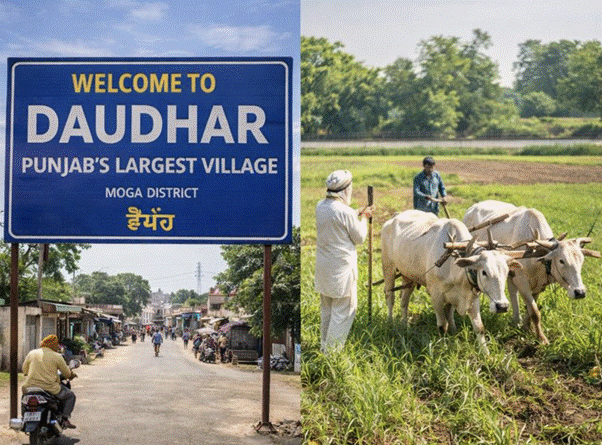
Largest Village in Punjab
Author : adminPublished : January 17, 2026
In Punjab, villages are rarely small. Many are expansive, land-rich, and deeply connected to agriculture. Yet even within this context, Daudhar, located in Moga district, stands out. It is widely referred to as Punjab’s largest village, a label that immediately invites curiosity—but also confusion. Largest by what measure? Population? Land area? Economic footprint?
The truth is that Daudhar’s significance cannot be captured by a single statistic. What makes it remarkable is not just its size, but the fact that it has grown so large while remaining administratively and socially a village. It has not transitioned into a town, nor fragmented into smaller settlements. Instead, it has expanded inward—absorbing people, land, and livelihoods—while retaining a rural structure.
Daudhar matters because it represents an extreme but telling version of rural Punjab. It shows what happens when agriculture, land ownership, kinship networks, and migration interact over decades without the guiding hand of urban planning. In many ways, Daudhar is not an exception—it is a preview of where several large Punjabi villages are headed.
| population of Punjab | literacy rate of Punjab | sex ratio of Punjab |
Reading Daudhar on the Map: Land, Water, and Malwa’s Core

Daudhar lies in the Malwa region of Punjab, the state’s largest and most agriculturally productive belt. Situated in Moga district, it enjoys strong connectivity to nearby towns and mandis, making it well-integrated into Punjab’s agrarian economy.
Geography That Allowed Growth
The village sits on flat alluvial plains, a landscape shaped over centuries by river systems and sediment deposition. This geography offers three critical advantages:
- Fertile soil capable of sustaining intensive agriculture
- Ease of expansion, with few natural barriers to settlement growth
- Compatibility with mechanised farming, which rewards scale
Unlike hilly or semi-arid regions where villages often fragment, Malwa’s plains allowed Daudhar to expand continuously, both in population and cultivated land.
Water as Enabler—and Risk
Canal irrigation, introduced during the colonial period and expanded after Independence, transformed Daudhar into a high-yield farming village. Later, widespread use of tubewells further increased productivity. However, this same dependence on groundwater now places Daudhar at the centre of Punjab’s water sustainability crisis, making geography both its greatest asset and its greatest vulnerability.
What Does “Largest Village” Really Mean in Punjab?
Calling Daudhar Punjab’s largest village requires nuance. In Punjab, the distinction between village and town is often administrative rather than functional.
Different Ways of Measuring “Largest”
Villages can be compared using:
- Population size
- Number of households
- Total cultivated land
- Economic output
- Administrative status
Some settlements like Longowal or Toosa have larger populations but are now classified as towns or nagar councils. Daudhar, by contrast, remains a village in official records, despite functioning at a scale comparable to urban settlements.
Why Daudhar Stands Out
Daudhar’s claim rests on a combination of:
- Vast agricultural land under a single village boundary
- A large, stable rural population
- Continued village-level governance
It is not just “big”—it is structurally large, which makes it sociologically and economically significant.
How Daudhar Became So Big: A Story of Land, Kinship, and Agriculture
Daudhar’s growth is best understood not as a result of a single event, but as the outcome of long-term structural advantages combined with social choices. Like many villages in the Malwa region, Daudhar was settled by Jatt Sikh families who valued land ownership, collective living, and agricultural self-sufficiency. What distinguishes Daudhar is how these values interacted with geography and history to encourage consolidation rather than division.
Kinship and the Choice to Stay Together
In many parts of India, population growth leads villages to fragment, with new hamlets forming as families branch out. Daudhar followed a different path. Strong kinship ties, shared clan identity, and collective decision-making encouraged families to remain within a single village boundary. Marriage alliances, inheritance patterns, and social norms all reinforced this tendency to expand inward rather than split outward.
This cohesion reduced administrative fragmentation and allowed Daudhar to grow as a single, recognisable settlement over generations.
Agriculture as a Growth Engine
Land productivity played a decisive role. With the introduction of canal irrigation and later the Green Revolution, Daudhar’s fields became highly productive. As long as agriculture generated reliable income, the village could:
- Support a growing population
- Retain youth within farming households
- Absorb new residential clusters without economic strain
Growth, in this sense, was rewarded, not penalised. Daudhar became large because the agrarian system made size sustainable.
Life Inside a Giant Village: How Daudhar Actually Functions

From the outside, Daudhar’s scale can seem overwhelming. From the inside, however, life remains surprisingly localised and manageable.
Patti-Based Social Geography
Daudhar is organised into pattis or pinds, which function like semi-autonomous neighbourhoods. Each patti typically has:
- Closely related households
- Its own lanes and internal hierarchy
- Informal leaders or respected elders
This structure allows residents to experience daily life within a human-scale social unit, even though the village as a whole is enormous. People identify first with their patti, then with Daudhar, creating layered belonging.
Markets, Movement, and Daily Rhythm
Rather than a single central market, Daudhar has multiple small commercial nodes—tea shops, kirana stores, repair shops—distributed across the settlement. This decentralisation reduces the need for long daily commutes and keeps social interaction embedded within neighbourhoods.
Daily routines reflect this balance:
- Mornings in fields or local workspaces
- Midday rest and household activities
- Evenings spent at chaupals, gurdwaras, or sports grounds
Daudhar functions efficiently not because it is planned, but because social organisation compensates for the lack of formal urban planning.
Migration, Money, and the New Punjabi Village Economy
Over the past two to three decades, migration has emerged as the second pillar of Daudhar’s economy, alongside agriculture.
Why Migration Became Central
As landholdings fragmented and farming incomes stabilised rather than grew, younger generations began to look outward. Education, exposure, and global Punjabi networks made migration—both domestic and international—a viable and often aspirational path.
For many families, migration was not an abandonment of the village, but a strategy to sustain it.
The Transformative Impact of Remittances
Remittance income has reshaped Daudhar in visible and subtle ways:
- Large, concrete houses replacing older structures
- Increased private spending on education and healthcare
- Shifts in consumption, from basic subsistence to lifestyle goods
Importantly, remittances often flow back into the village, funding agricultural inputs, land purchases, or small businesses. This creates a feedback loop where external income reinforces local stability.
A Hybrid Rural Economy
Daudhar today operates within a hybrid economic model:
- Agriculture provides land-based identity and food security
- Migration provides cash flow, resilience, and aspiration
This dual system explains why Daudhar has not declined despite agricultural stress. However, it also introduces new inequalities—between migrant and non-migrant households—and raises questions about long-term sustainability if global migration opportunities shrink.
Farming at Scale: Agriculture That Built Daudhar
Agriculture is the foundation of Daudhar’s scale and stability.
Cropping Patterns
The village follows Punjab’s dominant wheat–paddy cycle, supported by:
- Mechanised inputs
- High-yield seed varieties
- Chemical fertilisers and pesticides
Large landholdings once made this model highly profitable, allowing families to reinvest in land, housing, and education.
The Hidden Costs of Scale
Today, the same system presents challenges:
- Declining groundwater levels
- Rising input costs
- Pressure to diversify crops
Daudhar illustrates a central paradox of Punjab’s agriculture: the model that enabled growth now threatens sustainability.
Migration, Money, and the New Punjabi Village Economy
Over the past few decades, Daudhar’s economy has diversified through migration.
Domestic and International Mobility
Youth from Daudhar increasingly pursue:
- Education and work in Indian cities
- Migration to countries like Canada and the UK
This mobility has not emptied the village. Instead, it has reshaped it.
Impact of Remittances
Remittance income has:
- Improved housing quality
- Increased spending on education
- Altered consumption patterns
Agriculture remains central, but Daudhar is no longer dependent on it alone. The village economy is now transnational, linked to global labour markets.
The Stress Points: Water, Youth, and the Limits of Growth
Daudhar’s success has created its own pressures.
- Groundwater depletion threatens agriculture
- Youth unemployment and underemployment persist
- Infrastructure lags behind population needs
- Drug-related concerns affect parts of the region
The village now faces limits that cannot be addressed by agriculture or migration alone.
Is Daudhar Still a Village? Thinking About Its Future
Daudhar sits at a crossroads.
Governance and Identity
There is increasing debate about whether Daudhar should:
- Remain a village
- Transition to a semi-urban administrative status
Each option carries trade-offs—between autonomy, access to resources, and cultural continuity.
What Daudhar Tells Us About Rural Punjab
Daudhar is not just Punjab’s largest village. It is a mirror reflecting:
- The strengths of Punjab’s agrarian model
- The costs of delayed transition
- The challenge of managing scale without urban tools
Its future will depend on whether rural governance can evolve without erasing rural identity.
Daudhar in 5 Key Insights
- Scale Without Urban Status
Daudhar functions at the scale of a small town, yet remains administratively a village—revealing the limits of India’s rural–urban classification. - Growth Through Staying Together
Unlike many settlements that split as they expand, Daudhar grew by consolidating land, families, and neighbourhoods within a single village boundary. - Agriculture Built It—Migration Sustains It
Farming enabled Daudhar’s rise, but remittances from domestic and international migration now play a critical role in its economic stability. - Neighbourhoods Make Size Livable
Patti-based social organisation allows daily life to remain local and manageable despite the village’s massive population. - A Mirror for Rural Punjab’s Future
Daudhar highlights both the strengths and stresses of Punjab’s agrarian model—offering lessons for other large villages navigating growth and transition.
Conclusion
Daudhar’s story is not about being the biggest. It is about what size does to a village—how land, labour, migration, and culture interact over time. In that sense, Daudhar is not an anomaly. It is a warning and a lesson.
As Punjab confronts questions of sustainability, employment, and rural transformation, Daudhar shows that the future of villages will not be decided by statistics alone—but by how thoughtfully growth is managed.
Latest Post
 City Of Peace In India
9/14/2026
 Highest Tax Paying City In India
9/13/2026
 City Of Light In India
9/12/2026
 City Of Hills In India
9/11/2026
 City of Gods in India
9/10/2026