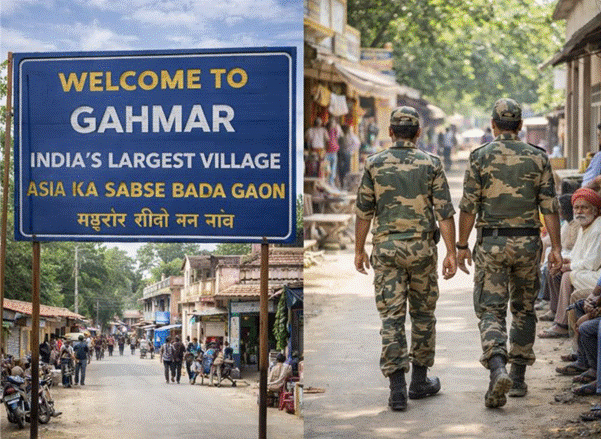
Largest Village in India
Author : adminPublished : January 23, 2026
In the vast rural landscape of India, where villages often number in the tens of thousands but remain modest in size, Gahmar stands apart. Located in eastern Uttar Pradesh’s Ghazipur district, Gahmar is widely identified as India’s largest village by population, and is frequently described in media and public discourse as Asia’s largest village. What sets Gahmar apart is not just its scale, but the way it functions—socially, economically, and culturally—like a small town while retaining a distinctly rural character.
Gahmar’s identity is built on two pillars. The first is its extraordinary size, with population estimates far exceeding those of typical Indian villages. The second is its reputation as a “village of soldiers,” a place from which thousands of men have served—and continue to serve—in the Indian Army, paramilitary forces, and other defence services. In many families, military service is not an exception but a tradition passed down across generations.
Together, these two identities make Gahmar unique: a single village that combines demographic scale, martial heritage, and rural continuity, offering a rare case study of how large rural settlements evolve in India.
| population of Uttar Pradesh | literacy rate of Uttar Pradesh | sex ratio of Uttar Pradesh |
2. Location and Setting
Gahmar is situated in Zamania tehsil of Ghazipur district, in eastern Uttar Pradesh. The village lies close to the Uttar Pradesh–Bihar border and stretches along the banks of the Ganga River, one of India’s most important and life-shaping rivers.
Geographic Setting
The physical landscape of Gahmar is defined by:
- Alluvial riverine plains, ideal for agriculture
- Fertile soil deposited by the Ganga over centuries
- Seasonal flooding that both sustains and threatens livelihoods
The Ganga plays a dual role in village life. On one hand, it provides fertile land, water for irrigation, and historical trade routes. On the other, it brings risks—flooding, erosion, and land loss—that villagers have learned to manage through adaptation rather than avoidance.
Strategic and Social Position
Its location near a state border and along a major river corridor has historically:
- Facilitated movement and migration
- Encouraged trade and settlement expansion
- Supported a population much larger than surrounding villages
Gahmar’s setting helps explain how it grew so large and why it developed a strong, resilient community structure.
3. Size, Population, and Demographics

Population: Numbers and Debate
According to Census 2011, Gahmar recorded a population of around 25,000, already making it one of the largest villages in India by official count. However, local estimates, administrative sources, and media reports suggest that Gahmar’s current population ranges between 1.2 and 1.35 lakh (120,000–135,000).
This gap exists because:
- Census counts rely on strict administrative boundaries
- Gahmar has expanded organically through adjoining tolas and settlements
- Population growth and migration patterns outpaced census cycles
Regardless of which figure one accepts, there is broad agreement that no other single village in India matches Gahmar’s scale.
Households and Community Composition
Gahmar consists of thousands of households, spread across multiple neighbourhoods. The village is dominated historically by Rajput communities, often identified in sources as Bhumihar, Kushwaha-linked, or related martial lineages, depending on historical interpretation.
This social composition played a significant role in shaping Gahmar’s military tradition, landholding patterns, and leadership structures.
4. Historical Background of Gahmar
Origins of the Settlement
Gahmar’s origin is commonly traced to around 1530 CE, when the village is said to have been founded by a Rajput chief—often named Kusum Dev Rao—linked to Bisen or Baish lineages, depending on historical sources.
The founding period coincided with:
- Expansion of agrarian settlements along the Ganga
- Rajput land grants and consolidation
- Increased importance of river-based agriculture
Growth Over Centuries
Several factors allowed Gahmar to grow continuously rather than fragment into smaller villages:
- Abundant fertile land supporting large populations
- Strong kinship networks, reducing village fission
- Martial traditions, which encouraged unity and collective identity
Over time, Gahmar absorbed surrounding habitations, gradually becoming a mega-village rather than spawning new independent settlements.
Timeline of Gahmar’s Growth (Quick View)
- c. 1530 CE – Gahmar is established by a Rajput chief (commonly identified as Kusum Dev Rao of Bisen/Baish lineage), marking the beginning of permanent settlement along the Ganga’s fertile plains.
- 16th–18th centuries – Expansion through agriculture and land grants; proximity to the Ganga supports population growth and economic stability.
- 19th century (Colonial period) – Martial traditions strengthen as residents increasingly join military and security services under British administration.
- Early–Mid 20th century – Post-Independence recruitment into the Indian Army and paramilitary forces accelerates, shaping Gahmar’s identity as a “village of soldiers.”
- 1960s–1980s – Population grows rapidly without village fission; Gahmar absorbs surrounding hamlets, emerging as an unusually large single settlement.
- 2011 – Census records Gahmar as India’s most populous village (around 25,000 officially within administrative limits).
- 2010s–Present – Media and administrative sources estimate the population at over 1 lakh, reinforcing Gahmar’s reputation as India’s (and Asia’s) largest village.
Gahmar’s growth was continuous, not sudden—driven by fertile land, strong kinship networks, and sustained military service rather than urbanisation or industrialisation.
6. Village Layout, Neighbourhoods, and Everyday Life

Given its extraordinary size, Gahmar does not function like a conventional Indian village. Instead, it operates as a clustered settlement, closer in scale and complexity to a small town, while retaining rural governance structures.
Internal Organisation and Neighbourhoods
Gahmar is divided into numerous tolas and mohallas, each with:
- Its own lanes, houses, and community identity
- Informal leadership figures and elders
- Small shrines, shops, and meeting points
These neighbourhoods function semi-independently, yet are socially interconnected through kinship, marriage networks, and shared institutions. This decentralised structure allows Gahmar to manage its size without fragmenting into separate villages.
Markets, Public Spaces, and Social Life
Unlike smaller villages with a single market area, Gahmar hosts multiple local bazaars serving different sections. Daily necessities—groceries, agricultural tools, tailoring, mobile repair, and eateries—are available within walking distance for most residents.
Social interaction revolves around:
- Chaupals (community platforms) where elders discuss local issues
- Tea stalls that act as informal news hubs
- Religious spaces that double as social gathering points
Evenings often see groups of young men engaged in physical training or discussions about defence recruitment, reflecting the village’s martial ethos.
7. Economy: Beyond Army Service
While Gahmar is rightly famous for its contribution to the armed forces, its economy is far more diversified than the label “village of soldiers” suggests.
Agriculture and Land Use
Agriculture remains a foundational livelihood. The fertile alluvial soil supports:
- Wheat and paddy as staple crops
- Sugarcane as a cash crop
- Seasonal vegetables and fodder crops
However, increasing population has led to land fragmentation, reducing average landholdings and pushing some families to rely more heavily on non-farm income.
The Role of Army Salaries and Pensions
Military service has created a relatively stable income stream:
- Regular salaries during service
- Pensions providing long-term financial security
These funds significantly influence village life by:
- Improving housing quality (brick homes, multi-storey buildings)
- Enabling private education for children
- Financing healthcare and marriages
Retired soldiers often become local opinion leaders, bringing organisational discipline and administrative experience into village governance.
Non-Farm Employment and Mobility
Beyond the army, residents engage in:
- Transport services
- Small-scale trading
- Teaching and clerical work
Youth migration to cities for education and employment has increased, but strong emotional and financial ties to Gahmar remain, ensuring continuous reinvestment in the village.
8. Religion, Culture, and Festivals
Religion and culture play a vital role in holding together a settlement of Gahmar’s scale.
Temples and Sacred Spaces
Gahmar is home to several temples and shrines, the most prominent being the Kamakhya Devi Temple, which acts as both a religious and cultural anchor. These spaces:
- Host daily worship
- Serve as venues for festivals and fairs
- Provide forums for collective decision-making
Festivals as Community Events
Major festivals—Holi, Diwali, Dussehra, and local melas—are celebrated on an unusually large scale, often involving:
- Processions
- Cultural performances
- Collective feasting
Martial pride is subtly woven into these celebrations, with honouring of soldiers and veterans forming part of public rituals.
Oral Traditions and Collective Memory
Stories of bravery, ancestral achievements, and military service are passed down orally. These narratives reinforce:
- Group identity
- Intergenerational continuity
- Respect for service and discipline
Such storytelling plays a crucial role in sustaining Gahmar’s self-image as a community bound by duty and resilience.
9. Infrastructure and Public Services
Gahmar’s scale presents a paradox: it has more facilities than most villages, yet insufficient infrastructure for its population size.
Connectivity and Services
The village benefits from:
- Road connectivity to Ghazipur, Zamania, and nearby towns
- Access to railway stations within short distance
- Presence of schools, banks, post offices, and basic health centres
Private coaching institutes and informal training centres—especially for defence exams—have emerged as important local institutions.
Structural Challenges
Despite these advantages, Gahmar faces persistent challenges:
- Congested roads not designed for heavy traffic
- Strain on sanitation and waste management systems
- Limited access to advanced healthcare facilities
- Inadequate drinking water infrastructure during peak seasons
Residents often argue that Gahmar’s needs now exceed what standard village-level administration can provide.
10. Challenges and the Future of India’s Largest Village
Managing Growth and Demographic Pressure
Population growth remains Gahmar’s most pressing challenge. As families expand and landholdings shrink:
- Agricultural viability declines
- Housing density increases
- Demand for jobs outside farming rises
Even the economic cushion provided by army income cannot fully offset these pressures.
Youth Aspirations and Migration
Younger generations increasingly pursue:
- Higher education
- Professional careers outside defence
- Urban lifestyles
While this broadens opportunity, it also raises questions about how Gahmar’s traditional identity will adapt to changing aspirations.
Aspirations for Administrative Change
A growing section of residents advocates for:
- Town or Nagar Panchayat status
- Enhanced infrastructure funding
- Better healthcare and education facilities
Such recognition could help bridge the gap between Gahmar’s population size and its governance capacity.
Balancing Tradition and Modernisation
The central challenge for Gahmar’s future lies in balance:
- Preserving its martial and cultural heritage
- Adapting governance to urban-scale needs
- Ensuring inclusive development
If managed thoughtfully, Gahmar could emerge not just as India’s largest village, but as a model for large rural settlements navigating transition.
Latest Post
 City Of Peace In India
9/14/2026
 Highest Tax Paying City In India
9/13/2026
 City Of Light In India
9/12/2026
 City Of Hills In India
9/11/2026
 City of Gods in India
9/10/2026