India last village in south
Author : adminPublished : February 26, 2026
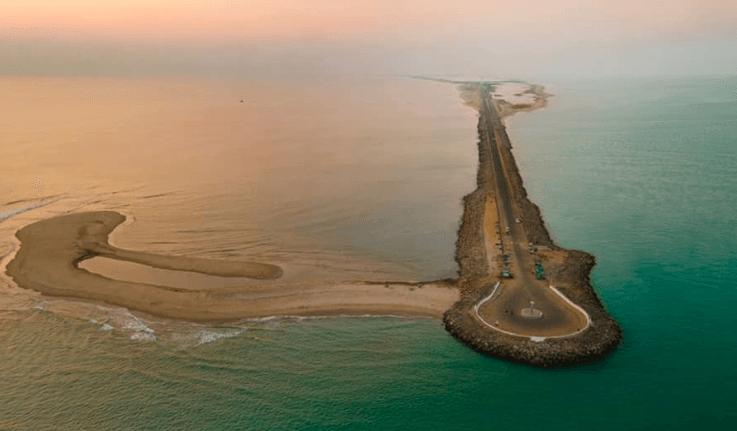
At the far southeastern edge of India, where the land thins into a fragile strip of sand and the sea begins to dominate every horizon, lies Dhanushkodi—a place that feels less like a destination and more like a boundary. Here, roads do not lead onward; they simply stop. On both sides of the narrow landmass, waves crash relentlessly, as if reminding visitors that this is not a place meant to last forever.
Often referred to as the “Last Road of India” or South India’s most famous ghost town, Dhanushkodi occupies the tip of Pamban Island near Rameswaram in Tamil Nadu, facing the Palk Strait, with Sri Lanka just 18–24 kilometres away across the water. For decades, this haunting stretch of land has captured the imagination of pilgrims, historians, travellers, and photographers alike.
What makes Dhanushkodi unique is not just its dramatic geography, but its layered identity. It is a place where ancient mythology, colonial history, and modern disaster intersect. Once a thriving coastal town with a railway station, port, homes, schools, and churches, Dhanushkodi was wiped off the map in a single night by the devastating Rameswaram cyclone of 1964. Since then, it has never been officially resettled.
Today, Dhanushkodi exists in a strange in-between state—uninhabited yet visited, destroyed yet remembered, a “last village” not because it is populated, but because it marks the edge of land itself. This article explores Dhanushkodi as one of India’s most powerful village extremes: a place where geography ends, history pauses, and the sea takes over.
| population of Tamil Nadu | literacy rate of Tamil Nadu | sex ratio of Tamil Nadu |

2. Location: India’s Last Drivable Point
2.1 Geography and Physical Setting
Dhanushkodi is located at the southeastern tip of Pamban Island in Ramanathapuram district, Tamil Nadu. Pamban Island itself is connected to mainland India by the iconic Pamban Rail Bridge and the Indira Gandhi Road Bridge, linking Rameswaram to the rest of Tamil Nadu.
Geographically, Dhanushkodi sits at a point where two major water bodies appear to converge:
- The Bay of Bengal on the eastern side
- The Indian Ocean (via the Gulf of Mannar) on the western side
This meeting point is popularly known as Arichal Munai, a narrow tongue of sand where waves from both sides are visible simultaneously—one of the most visually striking coastal features in India.
The terrain is fragile and constantly shifting. The land is composed almost entirely of sandbanks and dunes, shaped by strong coastal winds and tides. Vegetation is sparse, and there is no natural protection against storms or cyclones, making the area extremely vulnerable to extreme weather events.
2.2 Access and the “Last Road” Label
Dhanushkodi is approximately 18 kilometres from Rameswaram, but the journey feels much longer due to the nature of the road. After a point, the paved road gives way to a rough sandy track, accessible only by four-wheel-drive jeeps operated by local drivers. Private cars and buses are not permitted beyond the main checkpoint.
This is why Dhanushkodi is popularly called the “Last Road of India”—not in an official administrative sense, but experientially. The road ends, there are no signboards pointing forward, and beyond the final stretch of sand lies only open sea and the distant outline of Sri Lanka.
2.3 Clarifying the “Last Village” Claim
It is important to clarify that:
- Dhanushkodi is not the southernmost point of India (that distinction belongs to Indira Point in the Andaman & Nicobar Islands).
- However, Dhanushkodi is widely regarded as the last drivable coastal point on the Indian mainland, before the sea route toward Sri Lanka begins.
This distinction is central to understanding why Dhanushkodi holds such symbolic weight in discussions of India’s geographic extremes.
3. Mythological Significance: The Birthplace of Ram Setu
Long before Dhanushkodi became associated with disaster and abandonment, it occupied a sacred place in Indian mythology. Its very name is rooted in the Ramayana, one of Hinduism’s most revered epics.
The word “Dhanushkodi” translates roughly to “end of the bow”. According to tradition, this is the point where Lord Rama, after defeating Ravana in Lanka, broke his divine bow and marked the end of his journey. Another widely held belief states that this was the spot from which Rama aimed his bow toward Lanka, directing the construction of Ram Setu—the legendary bridge of stones built by the Vanara army to cross the sea.
3.1 Ram Setu and Sacred Geography
From the shores of Dhanushkodi, on clear days, visitors can observe the shallow shoals and sandbanks stretching toward Sri Lanka. These formations are popularly identified as Ram Setu (Adam’s Bridge), a chain of limestone shoals that has been the subject of religious belief, scientific study, and political debate.
For pilgrims, Dhanushkodi is not just a ruin—it is an extension of the Rameswaram pilgrimage circuit, one of the four sacred Char Dham sites. A visit to Dhanushkodi is often seen as the symbolic completion of the spiritual journey.
3.2 Arichal Munai: Where Seas Converge
Another important mythological and spiritual landmark is Arichal Munai, believed by many devotees to be the place where the Bay of Bengal meets the Indian Ocean. While oceanographers may debate the technical accuracy of this claim, its symbolic value remains immense.
Pilgrims traditionally take a holy dip here, believing that the convergence of waters holds purifying power. Even today, despite the absence of permanent settlement, Dhanushkodi attracts lakhs of pilgrims annually, underscoring its enduring religious significance.
4. The 1964 Catastrophe: From Thriving Town to Ghost Village
Until the mid-20th century, Dhanushkodi was very much alive.
4.1 Life Before the Cyclone
In the early 1900s, Dhanushkodi was a bustling coastal town and port, playing a key role in trade and transport between India and Ceylon (modern-day Sri Lanka). The town had:
- A railway terminus connected to mainland India
- A functioning port
- Over 500 houses, schools, a post office, a police station
- A church, temples, and commercial establishments
Passenger trains regularly ran between Pamban and Dhanushkodi, and ferries carried people and goods across the strait. The town represented modern coastal life at India’s edge.
4.2 The Night Everything Changed
On the night of 22 December 1964, a powerful cyclone struck the Tamil Nadu coast. Winds reached speeds of up to 280 km/h, and massive tidal waves—estimated at over 7 metres high— swept across Dhanushkodi.
The most haunting tragedy occurred when the Pamban–Dhanushkodi passenger train was caught in the storm. The train was washed off the tracks into the sea, killing over 115 passengers instantly.
By morning, Dhanushkodi no longer existed as a town.
Official estimates suggest that around 1,800 people lost their lives. Homes, railway lines, and infrastructure were completely destroyed. The government later declared Dhanushkodi “unfit for human habitation”, and survivors were relocated to safer areas, primarily Rameswaram.
4.3 Aftermath and Abandonment
Railway services were permanently discontinued, the port was shut down, and no formal reconstruction was undertaken. What remained were roofless buildings, broken church walls, half-buried railway platforms, and silence.
When the 2004 Indian Ocean tsunami briefly exposed more submerged ruins along the coast, it reinforced Dhanushkodi’s reputation as a cursed or forbidden land—a place reclaimed by nature.
From that moment onward, Dhanushkodi transformed into what it is today: India’s most famous ghost village, frozen between memory and sea.
5. Dhanushkodi Today: A Ghost Town Turned Pilgrimage and Tourism Magnet
More than six decades after its destruction, Dhanushkodi has not returned to life—but it has not been forgotten either. Instead of homes and markets, the town now hosts ruins, sand, sea, and memory, drawing thousands of visitors every day.
5.1 What Remains on the Ground
Walking through Dhanushkodi today feels like stepping into a paused timeline. Scattered across the sandy landscape are the skeletal remains of what was once a fully functional town:
- A roofless church with arched windows staring into the sky
- The remains of a railway station platform, half-buried in sand
- Broken school walls, residential foundations, and a post office shell
- A small temple gopuram, standing resilient despite decades of exposure
These structures are not preserved monuments in the conventional sense. They are raw ruins, constantly reshaped by wind and tide. Sand drifts in and out of rooms, waves erode foundations, and each monsoon subtly alters the layout.
5.2 Human Presence Without Settlement
Although Dhanushkodi has no permanent residents, it is not entirely devoid of human life. A small number of seasonal fishermen set up temporary huts along the coast during calmer months. These huts have:
- No permanent electricity
- No piped water
- No official civic infrastructure
Their presence is tolerated but closely regulated, as the area falls under coastal and disaster-prone zone restrictions. Once the fishing season ends or weather worsens, these settlements vanish, returning Dhanushkodi to near-total emptiness.
5.3 Tourism at the Edge
Tourism has become Dhanushkodi’s primary modern identity. Visitors typically arrive via:
- Government-regulated jeep services from Rameswaram
- Entry checkpoints charging a nominal fee
- Guided or semi-guided excursions lasting 1–2 hours
Key attractions include:
- The double-sea beach, where waves crash on both sides of land
- Views of Ram Setu shoals stretching toward Sri Lanka
- Sunrise and sunset photography at Arichal Munai
Despite its ghost-town status, Dhanushkodi is now one of Tamil Nadu’s most visited coastal attractions, especially during the pilgrimage season.
6. Dhanushkodi in India’s “Village Extremes” Narrative

Dhanushkodi occupies a unique place in any discussion of India’s geographical or demographic extremes. Unlike other “last villages” that are defined by remoteness or border proximity, Dhanushkodi is defined by absence.
6.1 A Village That Disappeared
Most villages discussed in “India’s extremes” lists—such as northernmost, easternmost, or smallest villages—are still inhabited. Dhanushkodi is different:
- It was once a fully populated town
- It was officially declared uninhabitable
- It exists today as a named place without a living community
In this sense, Dhanushkodi represents an extreme case of total depopulation, rather than marginal survival.
6.2 Comparison with Other “Last Villages”
To place Dhanushkodi in context:
- Chitkul (Himachal Pradesh) is India’s last village toward Tibet—but it is thriving.
- Thang (Ladakh) lies near the LOC—but civilians still live there.
- Indira Point (Great Nicobar) is India’s southernmost inhabited point—but it supports a small population.
Dhanushkodi stands apart as a “lost village”—a place that marks the end of land, history, and habitation simultaneously.
6.3 Census and Administrative Status
Post-1964, Dhanushkodi does not function as a standard census village with population data. However:
- It retains official recognition as a place name
- It features in Tamil Nadu tourism and district records
- It continues to shape regional identity and pilgrimage routes
This makes Dhanushkodi an unusual but legitimate subject in any serious study of India’s village extremes.
7. Visiting Dhanushkodi: Practical and Ethical Considerations
While Dhanushkodi is open to visitors, it is not a casual beach destination. Its geography, history, and vulnerability demand a responsible approach.
7.1 How to Visit
- Base location: Rameswaram
- Transport: Government-approved jeeps only beyond the main road
- Time required: Half-day visit recommended
- Best season: October to February (calmer seas, better visibility)
Visitors are advised to carry:
- Drinking water and sun protection
- Minimal belongings (strong winds and sand)
- Cash for jeep services and entry fees
7.2 Safety and Restrictions
Due to its exposure:
- The area may be closed during cyclones or rough weather
- Swimming is dangerous due to strong undercurrents
- Entry beyond designated points is restricted
Authorities strictly prohibit:
- Overnight stays
- Construction or camping
- Drone usage without permission
7.3 Ethical Tourism
Dhanushkodi is not an amusement park—it is a site of collective trauma and memory. Responsible visitors should:
- Avoid vandalising or climbing ruins
- Not remove stones, shells, or artifacts
- Refrain from insensitive photography or behaviour
Supporting local jeep drivers and small vendors is encouraged, but commercial exploitation of ruins is discouraged.
8. Conclusion: India’s Edge, Frozen in Time

Dhanushkodi is not just the end of a road—it is the end of a chapter in India’s coastal history. Few places so starkly demonstrate how nature can erase human ambition, reducing a bustling town to silence in a single night.
Yet, Dhanushkodi is not merely a tragedy. It is also a place of profound symbolism:
- Where mythology meets geography
- Where pilgrimage meets loss
- Where India’s land dissolves into the sea
As part of India’s “village extremes” narrative, Dhanushkodi reminds us that not all villages shrink gradually—some vanish suddenly, leaving behind ruins that speak louder than living streets.
Standing at Dhanushkodi, with the wind howling and waves colliding on both sides, one realises that this “last village” is not defined by borders or population counts, but by its role as a silent witness—to faith, disaster, and the fragile line between land and ocean.
Latest Post
 City Of Light In India
9/12/2026
 City Of Hills In India
9/11/2026
 City of Gods in India
9/10/2026
 Busiest Cities In India
9/9/2026
 City of Flyovers in India
9/8/2026