India last village in north
Author : adminPublished : April 7, 2026
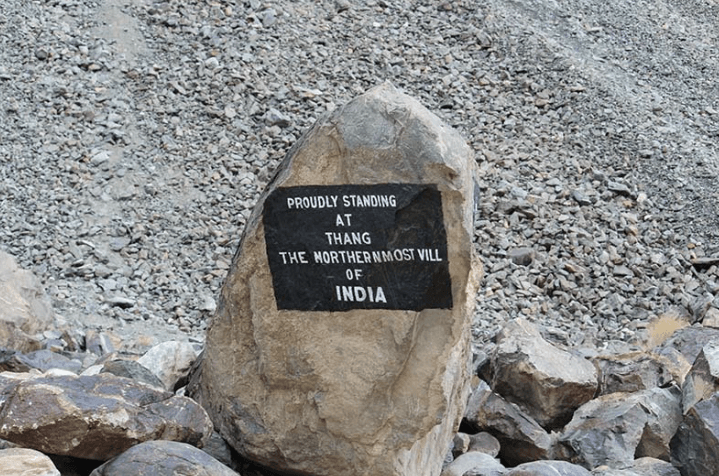
At 34°55′34″ North, where India narrows into a fragile ribbon of land facing the Line of Control (LoC), lies Thang—India’s northernmost inhabited civilian village. Located in the Chorbat region of Nubra Valley, Ladakh, Thang is not merely remote; it exists at the edge of sovereignty, just 2.5 kilometres from Pakistani military positions, separated only by the restless waters of the Shyok River.
Home to roughly 200–250 Balti Muslim residents across 50 households, Thang represents a rare and powerful contradiction: ordinary civilian life unfolding under extraordinary geopolitical tension. Apple orchards grow under the watch of army bunkers. Children walk to school past border fencing. Farmers till land that, until December 1971, lay inside Pakistan-occupied Baltistan.
What makes Thang exceptional among India’s 600,000+ villages is not only its latitude record, but its civilian legitimacy. Unlike Daulat Beg Oldi, which lies further north but is exclusively military, Thang remains a living village—with mosques, homes, farms, tourists, and daily rhythms intact.
Supported by the Indian Army, governed by Leh district administration, and culturally rooted in Baltistan heritage, Thang stands as India’s cartographic frontier made human—a place where borders are not lines on maps but realities visible from backyards.
| population of Jammu and Kashmir | literacy rate of Jammu and Kashmir | sex ratio of Jammu and Kashmir |
2. Location Deep Dive: Chorbat LoC Frontier
2.1 Terminal Coordinates and Setting
| Parameter | Specification |
| Union Territory | Ladakh |
| District | Leh |
| CD Block | Turtuk (Nubra) |
| Coordinates | 34°55′34″N, 76°47′42″E |
| Elevation | ~2,900 metres (9,500 ft) |
| Distance from LOC | 2.5 km |
| Distance from Turtuk | 8 km |
| Population | ~200–250 |
| River | Shyok River |
Thang sits at the very end of civilian road access. Beyond it, movement is strictly military. The village lies on a narrow strip of fertile land along the Shyok River, which also functions as a natural and political boundary between India and Pakistan in this sector.
2.2 Strategic Geography
- Part of Baltistan region before Partition
- Captured by India during the 1971 Indo-Pak war
- Pakistani villages and posts clearly visible across the river
- Entry controlled by Indian Army checkpost
This geography makes Thang both vulnerable and vital—a settlement whose very existence reinforces territorial continuity.
Language, Identity & Border Memory (New Section 10A)
Balti Language: A Living Pre-Partition Archive
Thang is one of the last surviving pockets of the Balti language in India, a Tibetan-origin dialect historically spoken across Baltistan (now in Pakistan). Unlike Ladakhi or Urdu, Balti here survived without script change, remaining primarily oral—passed through family storytelling, folk songs, and prayer recitations.
Key linguistic traits:
- Tibetan grammatical base
- Persian and Arabic loanwords (Islamic influence)
- Shared vocabulary with villages across the LOC
For many elderly residents, Pakistan is not a foreign country—it is memory geography. Grandparents still point across the Shyok River describing:
- ancestral homes
- wedding routes
- grazing lands now inaccessible
This makes Thang not just a border village, but a linguistic and emotional frontier.
“The border came later. The river was always here.” — Elder resident, Thang
Education at the Edge: Growing Up at 34°55′N

Schooling Under Surveillance
Children in Thang attend school in Turtuk, requiring a daily 16 km round trip under army-monitored roads. Despite isolation, literacy rates exceed 85%, remarkable for a village so close to the LOC.
Educational challenges:
- No higher secondary school in-village
- Weather-related disruptions
- Limited digital infrastructure (improving post-2024)
Aspirations are changing:
- Army service
- Tourism entrepreneurship
- Civil services (first Ladakh batch post-UT status)
Education here is viewed as strategic empowerment, not just social mobility.
3. 1971 War Acquisition: From Baltistan to India
3.1 The Military Turning Point
Until December 1971, Thang was administered by Pakistan as part of Baltistan. During the Indo-Pak War, a daring operation led by Major Chewang Rinchen of the Ladakh Scouts (21 CAV) resulted in the capture of Turtuk, Thang, Chalunkha, and Tyakshi—a rare instance where territory changed hands permanently.
| Phase | Outcome |
| Pre-1971 | Pakistan-administered Baltistan |
| Dec 1971 | Indian Army capture |
| Post-1971 | Civilian governance retained |
| 2020 | Integrated into UT of Ladakh |
3.2 Civilian Continuity
Unlike many conflict zones, Thang witnessed no mass displacement. The Balti Muslim population remained, retaining:
- Language (Balti)
- Religion (Sunni Islam)
- Agricultural practices
- Family ties across the LOC (now separated)
For villagers, the transition was administrative, not cultural—a rare case of border realignment without social rupture.
4. Army–Civilian Symbiosis: Living Beside the LOC

Thang functions under a unique coexistence model where civilian life and military infrastructure are tightly interwoven.
4.1 Security Architecture
| Military Element | Civilian Interface |
| Army checkpost | Mandatory ID verification |
| Border fencing | Visible from farms |
| Observation bunkers | Guided tourist viewpoints |
| Patrol roads | Shared access routes |
4.2 Daily Interaction
- Morning briefings between village elders and army units
- Farming allowed close to fencing under supervision
- Loudspeaker alerts for weather or security advisories
- Joint vigilance during heightened tensions
Rather than restricting life, the army’s presence enables civilian survival, providing:
- Medical aid
- Emergency logistics
- Infrastructure support
This model transforms Thang into a living example of civil-military cooperation at the border.
5. Agricultural Economy: Orchards at the Line of Control
Against expectations, Thang sustains a productive horticulture economy in the shadow of conflict.
5.1 Orchard Profile
| Crop | Role |
| Apricots | Primary cash crop |
| Apples | Export-grade |
| Walnuts | High-value seasonal |
| Barley & wheat | Subsistence |
Farms often lie within 500 metres of the LOC, making Thang one of the closest farming communities to an active international border in the world.
5.2 Economic Output
- Estimated village GDP: ₹2–3 crore annually
- Army assistance in:
- Irrigation channels
- Road access
- Cold storage logistics
Agriculture here is not symbolic—it is fully functional, profitable, and resilient.
6. Balti Muslim Culture: A Living Baltistan in India
Thang preserves Baltistan culture more authentically than many areas across the LOC.
6.1 Cultural Continuity
| Element | Status |
| Language | Balti dominant |
| Religion | Sunni Islam |
| Cuisine | Buckwheat, apricot oil |
| Dress | Traditional Balti woollens |
6.2 Religious Life
- One central mosque (pre-1971 structure)
- Daily prayers conducted with army coordination
- Ramadan and Eid observed collectively
Despite geopolitical division, Thang remains a cultural bridge to Baltistan, preserving traditions frozen in time since 1971.
7. Tourism Protocol: Army-Guided Border Experience

Thang is one of the very few LOC-adjacent villages in India open to tourists.
7.1 Entry Requirements
| Requirement | Details |
| Inner Line Permit | Issued in Leh |
| Army checkpost | ID + security questions |
| Local guide | Mandatory |
| Photography | Permitted (rare for LOC areas) |
7.2 Visitor Experience
Typical 3-hour visit includes:
- Army checkpost briefing
- Border fence viewpoints
- Shyok River crossing visuals
- Pakistani post spotting
Cost: ~₹1,200 per person
Tourism here is controlled, educational, and deeply patriotic, offering a rare, sobering insight into life at India’s northern edge.
8. Shyok River Lifeline: Nature as the Border
Flowing silently beside the village, the Shyok River is more than a water source for Thang—it is a geopolitical marker, agricultural artery, and psychological boundary. Originating from the Rimo Glacier near Siachen, the Shyok travels westward before entering Pakistan-occupied Baltistan, making it one of the rare rivers that flows from India into contested territory.
8.1 Hydrological Significance
| Feature | Strategic Role |
| Origin | Rimo Glacier (Siachen region) |
| Function | Natural LOC marker |
| Irrigation | Primary water source for orchards |
| Flood Risk | Seasonal, managed by army dredging |
The river’s floodplains act as an informal buffer zone, a no-man’s-land where civilian movement is restricted but visibility across borders is constant. During summers, villagers can clearly see Pakistani settlements and patrols on the opposite bank—turning geography into a daily reminder of division.
8.2 Agricultural Dependence
- Gravity-fed canals draw water from Shyok
- Apple, apricot, and walnut orchards depend on snowmelt-fed flow
- Army engineering units assist in post-flood desilting
In Thang, nature defines the border, not barbed wire alone—making the Shyok both a lifeline and a frontier.
9. Household Economy: Border Resilience Model

Despite its isolation and security constraints, Thang sustains a diversified micro-economy, carefully balanced to withstand geopolitical uncertainty.
9.1 Income Composition
| Source | Approx. Annual Revenue (₹ lakh) |
| Orchard produce | 150 |
| Homestays & tourism | 80 |
| Army-linked contracts | 40 |
| Walnut & apricot trade | 30 |
Estimated village GDP: ~₹3 crore annually
9.2 Economic Resilience Strategies
- Agriculture-first model: Low external dependency
- Seasonal tourism (May–September only)
- Army employment (road works, logistics, maintenance)
- Cross-border kinship remittances (indirect, informal)
This layered economy allows Thang to survive sudden closures, tourism bans, or military alerts—a necessity for life at the LOC.
10. National Benchmarking: India’s Extreme Frontier Villages
Thang’s status becomes clearer when placed alongside other “extreme” Indian villages.
10.1 Northern & Border Comparisons
| Village | Latitude | Status |
| Thang (Ladakh) | 34°55′N | Northernmost civilian |
| Daulat Beg Oldi | 35°23′N | Military-only |
| Kibithu (Arunachal) | 28°00′N | Easternmost |
| Chitkul (Himachal) | 31°21′N | Westernmost civilian |
10.2 What Makes Thang Unique
- Civilian habitation at extreme latitude
- Muslim-majority village on LOC
- Tourism permitted with photography
- Captured territory with retained population
Thang is not just geographically extreme—it is politically, culturally, and administratively singular in India.
11. Vibrant Villages Programme: National Priority Settlement
Recognizing its strategic importance, Thang has been placed under India’s Vibrant Villages Programme, which focuses on strengthening border habitations.
11.1 Development Interventions (2024–2028)
| Initiative | Status |
| Infrastructure funding | ₹50 crore sanctioned |
| Solar electrification | 100% coverage |
| 4G connectivity | BSNL + Army towers |
| Homestay upgrades | 20 rooms modernised |
11.2 Strategic Intent
- Prevent out-migration from border villages
- Use tourism + livelihood as deterrents to depopulation
- Showcase civilian presence as strategic strength
Thang is now positioned as a model border village, where development itself becomes a form of national security.
12. Visiting India’s Northernmost Village: LOC Pilgrimage
Visiting Thang is not casual tourism—it is a frontier experience that blends geography, history, and patriotism.
12.1 Access Route
Leh → Diskit → Turtuk → Thang (2 days)
Requirements:
- Inner Line Permit (Leh)
- ID verification at army checkposts
- Mandatory local guide
12.2 Visitor Experience
- Army bunker viewpoints
- Shyok River LOC boundary
- Pakistani posts visible across river
- Balti homestay lunch
Cost: ~₹2,500 per person
Best season: May–October
Restrictions: No drones, modest dress, no night stay without approval
Standing in Thang is less about sightseeing and more about standing at India’s edge.
13. Life at the LOC: Normalcy Under Surveillance
For residents, the border is not dramatic—it is routine.
Daily Reality
- Children commute to school in Turtuk (8 km)
- Army personnel are seen as protectors, not disruptors
- Loudspeakers replace phone alerts during emergencies
- Pakistani relatives visible—but unreachable—across the river
This normalization of conflict geography is perhaps Thang’s most striking feature: life continues calmly where maps scream tension.
14. Conclusion: India’s Northern Frontier Masterpiece
Thang stands at India’s northern latitude limit, but it is far from marginal. It is a living assertion of sovereignty, where Balti Muslim families farm orchards under army protection, sustain a ₹3 crore economy, welcome tourists, and preserve a culture older than the border itself.
Success equation:
Military–civilian symbiosis + orchard economy + controlled tourism = viable LOC village
Validated by:
- 1971 war records
- Leh district administration
- Vibrant Villages Programme inclusion
Thang is not merely India’s northernmost village—it is a lesson in how borders can be lived, not just guarded.
Series placement:
Physical → Digital → Human → Environmental → Artistic → Temporal → Aquatic → Demographic → Faunal → Herpetological → Geographical → Northern extreme
Latest Post
 City of Forts in India
10/5/2026
 City of Pearls in India
10/4/2026
 City of Gates in India
10/3/2026
 City of Bridges in India
10/2/2026
 City of Black Diamond in India
10/1/2026
 Muslim Cities in India
9/30/2026
 Gold City in India
9/29/2026
 Gambling City in India
9/28/2026
 Cotton City in India
9/27/2026
 City of Rallies in India
9/26/2026
 City of Kings in India
9/25/2026
 Greenest City in India
9/24/2026
 Vegetarian City in India
9/23/2026
 Floating City in India
9/22/2026
 Dry City in India
9/21/2026