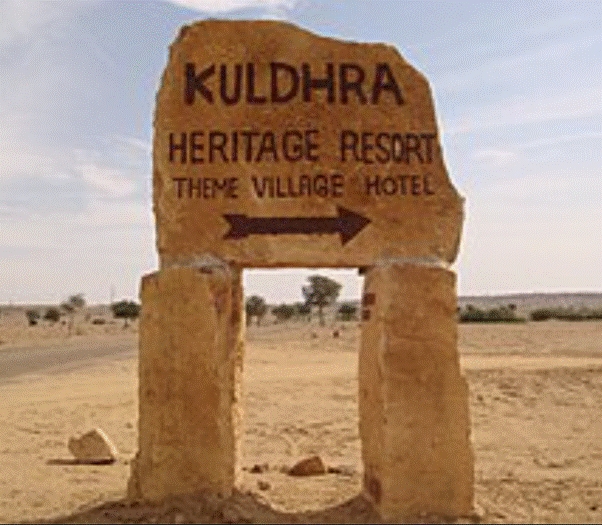
Haunted Village In Rajasthan
Author : adminPublished : January 13, 2026
In the heart of Rajasthan’s Thar Desert lies a village frozen in time—Kuldhara, often labelled as India’s most haunted village and the ghost village of Rajasthan. Unlike typical tourist destinations bustling with life, Kuldhara stands silent, its abandoned houses and empty streets telling a story that blends history, legend, and mystery. For decades, travellers, historians, paranormal enthusiasts, and content creators have been drawn to this village near Jaisalmer, intrigued by its sudden abandonment and chilling folklore.
Kuldhara’s reputation as a haunted site stems from a powerful narrative: an entire village allegedly deserted overnight, leaving behind a curse that prevents anyone from settling there again. This belief has turned Kuldhara into one of the most talked-about abandoned villages in India. Today, it exists simultaneously as a protected archaeological site and a popular haunted tourism attraction.
However, beyond the ghost stories lies a deeper, more complex reality involving environmental challenges, economic pressures, and social transitions. To truly understand Kuldhara, one must explore both the mythical narratives and the historical evidence, while recognising how modern tourism and digital media have shaped its current image.
| population of Rajasthan | literacy rate of Rajasthan | sex ratio of Rajasthan |
2. Where Is Kuldhara?
Kuldhara is located approximately 17 to 20 kilometres west of Jaisalmer city, in the Jaisalmer district of Rajasthan, close to the India–Pakistan border region. The village is easily accessible via the Jaisalmer–Sam road, a route frequently used by tourists travelling towards Sam Sand Dunes and desert camps.
Geographic and Environmental Setting
- Region: Thar Desert
- Terrain: Sandy plains with rocky patches
- Climate: Arid desert climate
- Average rainfall: Less than 200 mm annually
- Temperature range:
- Summer: Up to 48°C
- Winter: Can fall below 10°C
The surrounding landscape is stark and unforgiving. Sparse vegetation, long stretches of silence, and vast open skies dominate the scene. This isolation significantly contributes to the village’s mystique. Unlike abandoned settlements reclaimed by nature, Kuldhara remains exposed and barren, reinforcing its eerie atmosphere.
The remoteness also played a crucial role historically. Survival in this region depended entirely on effective water management and stable governance—factors that later contributed to the village’s decline.

3. Historical Background
Origins and Settlement
Kuldhara was established around the 13th century by the Paliwal Brahmins, a prosperous and influential community known for its scholarly traditions and administrative expertise. The Paliwals settled across western Rajasthan, founding more than 80 villages, with Kuldhara being one of the most prominent.
Economic Life in an Arid Land
Despite the harsh desert environment, Kuldhara flourished for centuries due to:
- Advanced rainwater harvesting systems
- Carefully designed stepwells and tanks
- Knowledge of dryland agriculture
- Trade connections with Jaisalmer city
Crops such as wheat, barley, gram, and mustard were cultivated using innovative techniques adapted to minimal rainfall. The village economy was also supported by trade and taxation systems linked to the Jaisalmer state.
Archaeological remains indicate a well-organised settlement, reflecting wealth, stability, and long-term planning rather than temporary habitation.
Timeline Summary of Kuldhara Village
- c. 1200–1300 CE: Kuldhara is founded by the Paliwal Brahmins as a planned desert settlement using advanced water-management systems.
- 13th–17th centuries: The village flourishes through agriculture, trade, and integration with the Jaisalmer kingdom.
- Late 17th–18th centuries: Increasing droughts and declining groundwater begin to strain agricultural sustainability.
- Late 18th century: Rising taxation and economic pressure weaken the village economy.
- Early 19th century: Gradual migration accelerates; folklore later associates this period with Diwan Salim Singh.
- 19th century: Kuldhara and neighbouring Paliwal villages are fully abandoned over time.
- Early 20th century: Oral legends of overnight abandonment and curses become widely established.
- Post-1947: The site gains recognition as a historical and archaeological location.
- Late 20th–early 21st century: Media and tourism popularise Kuldhara as “India’s most haunted village.”
- Present day: Kuldhara is a protected heritage site and a major cultural tourism attraction near Jaisalmer.

4. Why Was Kuldhara Abandoned?
The abandonment of Kuldhara remains the central question behind its haunted reputation. Two dominant explanations exist: legendary folklore and historical analysis.
4.1 Legend of Salim Singh and the Curse
The most widely circulated legend attributes Kuldhara’s abandonment to Salim Singh, the powerful Diwan (prime minister) of Jaisalmer in the early 19th century. According to folklore:
- Salim Singh allegedly desired a young woman from Kuldhara.
- He threatened the villagers with crippling taxes or violence if his demands were refused.
- To protect their honour, the entire village decided to leave.
The legend claims that one night, the residents of Kuldhara—and several nearby Paliwal villages—migrated silently. Before leaving, they cursed the land, declaring that no one would ever be able to live there again.
This curse is believed to be the reason why Kuldhara remains uninhabited even today.
4.2 Historical and Scientific Explanations
Historians present a more nuanced explanation supported by evidence:
- Declining water availability due to prolonged droughts
- Over-taxation imposed by the ruling administration
- Economic stress caused by changing trade routes
- Possible seismic activity affecting water structures
Archaeological surveys show no evidence of sudden abandonment. Instead, signs point to a gradual depopulation over decades. Such patterns were common in desert regions where environmental sustainability was fragile.
The “overnight disappearance” narrative likely emerged later as oral tradition simplified a slow decline into a dramatic story.
5. Reported Hauntings and Paranormal Claims
5.1 Village horror story Stories and Visitor Experiences
Kuldhara’s haunted reputation is reinforced by countless personal accounts. Commonly reported experiences include:
- Hearing footsteps or whispers
- Feeling sudden unease or heaviness
- Seeing shadowy figures
- Sudden drops in temperature
- Disorientation while walking through ruins
Several paranormal investigation teams have conducted overnight stays, claiming unexplained audio recordings, movement, and electromagnetic anomalies. However, none of these findings have been scientifically validated.
5.2 Skeptical View and Tourism Angle
From a scientific standpoint, no credible evidence supports paranormal activity in Kuldhara. Psychologists point to:
- Suggestion effect
- Expectation bias
- Environmental silence
- Ruined architecture triggering fear responses
Tourism authorities have nevertheless embraced the haunted narrative. Kuldhara is marketed as a “ghost village”, with legends highlighted alongside historical facts, increasing visitor interest and economic value.
6. The Village Layout and Architecture

Kuldhara’s ruins showcase impressive planning and architectural intelligence:
- Stone and mud houses designed for insulation
- Narrow streets to reduce heat exposure
- Temples at central locations
- Stepwells and tanks strategically placed
The orientation of streets and buildings reflects an understanding of wind patterns and sunlight—essential for desert survival. Even in ruin, Kuldhara stands as evidence of sophisticated settlement planning by the Paliwal Brahmins.
7. Kuldhara Today: Travel Guide
7.1 How to Reach and Best Time to Visit
- From Jaisalmer: 30–40 minutes by taxi
- Transport: Private cab or rental vehicle recommended
Best season: October to March
Best time of day: Early morning or sunset
7.2 Tickets, Timings, and Regulations
- Protected heritage site
- Nominal entry fee
- Informational signboards available
- Night entry restricted for safety reasons
Visitors are advised to carry water, wear protective clothing, and avoid venturing into unstable structures.
7.3 What to See and Do
Key highlights include:
- Main residential street
- Temple ruins
- Panoramic viewpoints
- Nearby Khaba Fort
- Desert photography opportunities
Kuldhara is often combined with visits to Jaisalmer Fort, Patwon Ki Haveli, and Sam Sand Dunes.
Absolutely. Below is a richly elaborated, website-ready expansion of Sections 8 and 9, written in a serious, authoritative, E-E-A-T compliant tone, with depth, examples, interpretation, and ethical framing.
You can directly replace Sections 8 and 9 in your article with the text below.
9. Balancing Myth, Memory, and Reality

Kuldhara is more than a collection of ghost stories. It is a cultural landscape shaped by centuries of human decision-making, environmental adaptation, and social organisation. While legends of curses and spirits add narrative richness, they should not obscure the broader historical lessons embedded in the village’s ruins.
Kuldhara as a Case Study in Environmental and Economic Stress
At its core, Kuldhara represents the vulnerability of human settlements in extreme environments. The village’s decline reflects:
- Long-term water scarcity
- Dependence on fragile ecological systems
- Economic pressure from taxation and governance
- Shifts in regional trade patterns
These factors are far more consistent with archaeological and historical evidence than the idea of supernatural abandonment.
The Role of Oral Tradition and Collective Memory
The legends surrounding Kuldhara are not meaningless fabrications. Oral traditions often emerge as communities attempt to preserve memory when written records are scarce. Over generations, complex socio-economic processes are condensed into symbolic stories—such as curses or overnight migrations—that are easier to transmit and remember.
In this sense, the folklore of Kuldhara reflects collective trauma, resistance to authority, and a desire to assert dignity, even if the literal details are not historically verifiable.
Ethical Storytelling and Cultural Responsibility
Presenting Kuldhara solely as a haunted attraction risks reducing a historically significant site to entertainment. Ethical storytelling requires:
- Clearly distinguishing legend from evidence
- Avoiding sensationalism that promotes fear over understanding
- Respecting the cultural heritage of the Paliwal Brahmin community
- Acknowledging the village as a place of human effort, not merely mystery
Tourism and media narratives have the power either to educate or to distort. Responsible representation can encourage visitors to appreciate Kuldhara as an archaeological and historical site rather than approaching it with voyeuristic curiosity.
Interpreting the Silence of Kuldhara
The silence of Kuldhara does not speak only of ghosts. It speaks of:
- A community that mastered desert survival
- A society that faced environmental and political limits
- A collective decision to migrate in search of sustainability
In this light, Kuldhara stands not as a cursed land, but as a powerful reminder of human resilience and adaptability. Its emptiness is not supernatural—it is historical. And understanding this reality allows the village to be remembered with respect, nuance, and depth.
Here is a clear, well-structured, SEO-friendly “Myths vs Facts” section, written in a neutral, authoritative tone that fits perfectly into your article.
You can add this as Section 10 or insert it after Section 9.
Myths vs Facts: Understanding the Truth About Kuldhara Village
Over time, Kuldhara’s identity has been shaped as much by storytelling as by history. While myths play an important cultural role, distinguishing them from verifiable facts is essential for responsible understanding and ethical tourism. Below is a clear comparison between popular beliefs and historical evidence.
Myth 1: Kuldhara Was Abandoned Overnight
The Myth:
It is widely believed that the entire population of Kuldhara vanished in a single night, leaving behind fully intact homes and streets.
The Facts:
Archaeological studies and structural analysis indicate gradual abandonment over several years or decades, not a sudden overnight exodus. Many houses show signs of long-term deterioration rather than hurried departure. Gradual migration was common in desert regions facing sustained environmental stress.
Myth 2: A Powerful Curse Prevents Anyone From Living in Kuldhara
The Myth:
The Paliwal Brahmins allegedly cursed the land before leaving, declaring that no one would ever be able to resettle in Kuldhara.
The Facts:
There is no historical or legal record of such a curse. Kuldhara remains uninhabited primarily because:
- Water scarcity persists
- The area lacks modern infrastructure
- It is protected as a heritage site
The absence of permanent residents is administrative and environmental, not supernatural.
Myth 3: Kuldhara Is Actively Haunted by Spirits
The Myth:
Visitors often believe that ghosts roam the village, causing strange sounds, sightings, and sensations.
The Facts:
No scientific or peer-reviewed evidence supports paranormal activity in Kuldhara. Reported experiences are best explained by:
- Wind acoustics through ruins
- Temperature fluctuations in desert conditions
- Psychological suggestion and expectation bias
- Sensory deprivation in silent environments
Myth 4: Paranormal Investigations Have Proven Supernatural Activity
The Myth:
Television shows and online videos claim that investigations have confirmed ghostly presence through devices and recordings.
The Facts:
These investigations are not scientifically validated. They lack:
- Controlled conditions
- Independent verification
- Reproducible results
Most are designed for entertainment rather than empirical research.
Myth 5: Fear Is the Reason No One Settles in Kuldhara Today
The Myth:
It is commonly believed that fear of ghosts prevents people from living in Kuldhara.
The Facts:
The real reasons include:
- Extreme desert climate
- Chronic water scarcity
- Legal protection as a heritage monument
- Lack of economic opportunity
Fear is a narrative explanation, not a practical barrier.
Myth 6: Kuldhara Was a Failed or Poorly Planned Village
The Myth:
Some assume Kuldhara was abandoned because it was poorly designed or unsustainable.
The Facts:
On the contrary, Kuldhara displays advanced urban planning:
- Efficient water structures
- Climate-responsive architecture
- Organised street layout
Its decline resulted from external pressures, not internal failure.
Myth 7: Kuldhara Is Unique in Being Abandoned
The Myth:
The village is often portrayed as an exceptional case of mysterious abandonment.
The Facts:
Several Paliwal Brahmin villages in the region were abandoned around the same period due to similar environmental and economic pressures. Kuldhara stands out mainly because:
- Its ruins are well preserved
- Its story was popularised through media
Why Myths Persist: Cultural Memory and Storytelling
Myths surrounding Kuldhara persist because they serve important social functions:
- They simplify complex historical processes
- They preserve collective memory where written records are limited
- They transform loss and migration into meaningful narratives
Understanding myths as symbolic memory rather than literal truth allows us to respect cultural traditions without misrepresenting history.
Conclusion: Seeing Kuldhara Clearly
Kuldhara does not lose its significance when myths are questioned. In fact, it becomes more meaningful. Seen clearly, Kuldhara is:
- A lesson in environmental sustainability
- A reflection of political and economic power dynamics
- A testament to human adaptability in extreme conditions
By separating myth from fact, visitors and readers can appreciate Kuldhara not merely as a haunted village, but as a powerful historical site that deserves thoughtful engagement and respect.
Latest Post
 City Of Peace In India
9/14/2026
 Highest Tax Paying City In India
9/13/2026
 City Of Light In India
9/12/2026
 City Of Hills In India
9/11/2026
 City of Gods in India
9/10/2026