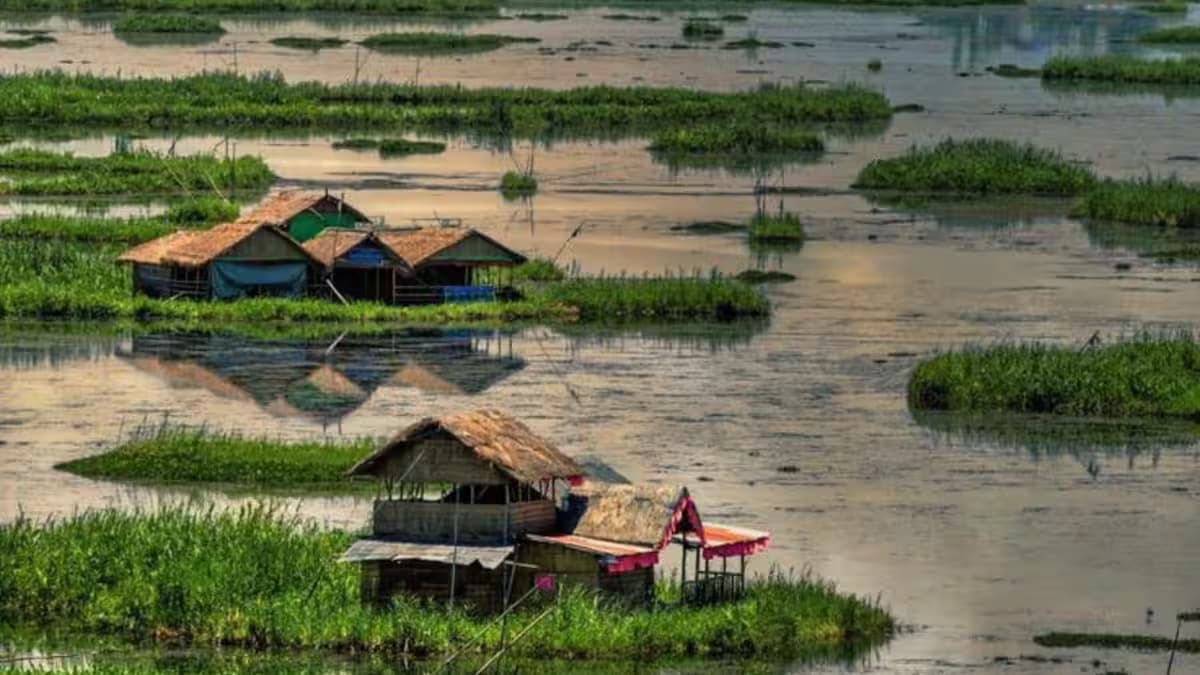
Floating village in India
Author : adminPublished : April 3, 2026
In a world where villages are defined by soil, roads, and fixed boundaries, Champu Khangpok defies every conventional idea of human settlement. Floating gently on the vast waters of Loktak Lake in Manipur, this extraordinary village is not built near water—it is built on water. Houses drift, paths shift, and the ground beneath residents’ feet is neither land nor boat, but phumdi—a naturally occurring floating mass of vegetation, soil, and organic matter.
Champu Khangpok is widely regarded as India’s most famous floating village and is often described as the only permanent natural floating village in the world. Unlike artificial houseboats or seasonal stilt settlements, the village exists entirely on naturally formed floating islands, sustaining human life year-round. Estimates suggest 400–2,000 residents, living across 134 to nearly 500 floating huts, depending on seasonal water levels and phumdi movement.
This village exists within one of India’s most ecologically sensitive regions. Loktak Lake is a Ramsar Wetland of International Importance and is also home to Keibul Lamjao National Park, the world’s only floating national park, famous for sheltering the endangered Sangai deer, Manipur’s state animal. The coexistence of a human settlement and a floating wildlife reserve makes Champu Khangpok a rare case study in hydrodynamic human ecology.
From fishermen casting nets directly from their doorsteps to children paddling canoes to school, life here has evolved in harmony with water movement, seasonal flooding, and floating land regeneration. Champu Khangpok is not an experiment—it is a living civilization, refined over generations, demonstrating how humans can adapt to extreme natural environments without conquering them.
| population of Manipur | literacy rate of Manipur | sex ratio of Manipur |

Location Deep Dive – The Loktak Lake Ecosystem
Geographical Setting
Champu Khangpok is located within Loktak Lake, the largest freshwater lake in Northeast India, in Bishnupur district, Manipur. The lake lies in the heart of the Imphal Valley, surrounded by low hills and fed by multiple rivers and streams.
| Attribute | Details |
| State | Manipur |
| District | Bishnupur |
| Lake Area | ~287 sq km (monsoon), ~98 sq km (winter) |
| Elevation | ~768 m above sea level |
| Ramsar Status | Declared in 1990 |
| Climate | Subtropical monsoon |
Seasonal water fluctuations dramatically alter the lake’s size, which in turn affects the movement, grounding, and regeneration of phumdi. This seasonal rhythm governs village life.
Ecological Importance of Loktak
Loktak Lake is not just a water body; it is an entire floating ecosystem. The lake supports:
- Over 230 aquatic plant species
- 425 species of animals, including fish, birds, and mammals
- The only floating protected forest in the world
Champu Khangpok exists in the buffer zone of this sensitive ecosystem, making its survival intricately tied to the health of the lake. Any hydrological change—natural or man-made—directly impacts the village’s stability.
What makes Loktak globally unique is the presence of phumdi, without which Champu Khangpok could not exist.
Phumdi Science – How Floating Land Is Formed
What Is Phumdi?
Phumdi is a naturally occurring floating biomass composed of:
- Decomposed vegetation
- Soil and organic sediment
- Living plant roots
- Trapped air pockets that provide buoyancy
These floating islands can range from a few meters to several square kilometers in size and are thick enough (2–3 meters) to support huts, vegetation, livestock, and even wild animals.
Scientific Composition
| Component | Approx. Share | Function |
| Organic matter | ~60% | Structural base |
| Soil & silt | ~30% | Weight balance |
| Living vegetation | ~10% | Regeneration |
| Air voids | ~40% volume | Buoyancy |
The buoyancy of phumdi comes from air trapped between decomposing plant layers. Over time, new vegetation grows on top, reinforcing the structure.
Seasonal Life Cycle of Phumdi
- Monsoon (June–October):
High water levels cause phumdi to float freely, drifting across the lake. - Winter (November–May):
Lower water levels allow phumdi to touch the lakebed, absorbing nutrients. - Regeneration Phase:
Nutrient absorption strengthens the biomass for the next floating cycle.
This cycle is essential for phumdi survival. Disruption of water levels (such as by dams or barrages) threatens the entire system.
Human residents of Champu Khangpok have adapted their architecture and lifestyle around this natural rhythm.
Village Architecture – How Floating Homes Are Built

Khangpok Shang: The Floating Hut
The houses of Champu Khangpok, locally known as Khangpok Shang, are lightweight, flexible, and designed to move with the phumdi rather than resist it.
| Feature | Specification |
| Shape | Circular or oval |
| Diameter | 8–10 meters |
| Materials | Bamboo, thatch, mud |
| Foundation | Directly on phumdi |
| Anchoring | Bamboo poles inserted into phumdi |
| Lifespan | 6–12 months |
Because phumdi regenerates and shifts, huts are often rebuilt annually. This constant rebuilding is not seen as hardship but as a normal part of life.
Village Layout
The village has no permanent streets or plots. Instead:
- Bamboo walkways connect huts temporarily
- Clusters of 5–7 huts form family units
- Open spaces emerge organically as phumdi shifts
This is an example of organic urbanism, where settlement design evolves naturally rather than being imposed.
Daily Life – A Fishing-Centric Civilization
Economic Backbone: Fishing
Fishing is the primary livelihood in Champu Khangpok. Residents use:
- Traditional bamboo traps
- Circular nets
- Seasonal fish enclosures built from phumdi
Fish are sold in floating markets and transported by canoe to mainland markets in Imphal.
Household Economy (Approx.)
| Income Source | Share |
| Fishing | 60% |
| Vegetable cultivation | 20% |
| Government welfare | 15% |
| Tourism | 5% |
Residents also grow vegetables directly on phumdi—pumpkin, cucumber, and leafy greens—demonstrating floating agriculture.
Education & Health
Children often travel over an hour by canoe to attend mainland schools. Healthcare access is limited, with emergencies requiring boat transport—highlighting the village’s vulnerability despite its ingenuity.
Keibul Lamjao National Park – Floating Biodiversity
World’s Only Floating National Park
Adjacent to Champu Khangpok lies Keibul Lamjao National Park, spanning approximately 40 sq km of floating phumdi. It is the only national park on floating biomass anywhere on Earth.
The Sangai Deer
The park is famous for protecting the Sangai deer, also called the “dancing deer” due to its delicate gait on floating vegetation.
| Feature | Details |
| Scientific name | Rucervus eldii eldii |
| Population (2025 est.) | ~260 |
| Adaptation | Hollow hooves for phumdi |
Human–Nature Tension
As both humans and wildlife depend on phumdi, space competition is inevitable. Conservation policies often restrict village expansion, while villagers argue for livelihood rights—making Champu Khangpok a focal point in debates on conservation vs. human survival.
Transportation – A Canoe Civilization

In Champu Khangpok, boats are not vehicles; they are lifelines. With no roads, bridges, or solid ground, every movement—economic, social, educational, and medical—depends entirely on canoe-based transport. The village represents one of the last remaining pure water-transport civilizations in India.
Types of Boats Used
| Boat Type | Purpose | Capacity |
| Dugout wooden canoe | Daily fishing, family transport | 2–3 people |
| Bamboo-planked canoe | Cargo & nets | 3–5 people |
| Fibre-reinforced canoe (govt.) | School & emergencies | 10–15 people |
| Motorized boats | Market access, health emergencies | 15–20 people |
Traditionally carved from single tree trunks, dugout canoes are now slowly being replaced by fibre boats distributed under fisheries and livelihood schemes.
Navigation Challenges
- Constantly shifting phumdi block old routes
- No fixed landmarks; navigation is memory-based
- Fog and storms reduce visibility
- Night travel relies on solar lanterns
Residents often say:
“We don’t measure distance in kilometers, but in paddle strokes.”
This dependence on water mobility has shaped local skills, instincts, and even childhood development—children learn to paddle before they learn to write.
Government Interventions – Development vs Ecology
Champu Khangpok sits at the intersection of welfare delivery and environmental regulation. Any development intervention must balance human survival with wetland conservation.
Key Government Initiatives (2020–2026)
| Scheme | Impact |
| Fisherman Identity Cards (NFDB) | Access to credit & insurance |
| Solar lantern distribution | Eliminated kerosene use |
| Floating drinking-water filters | Reduced water-borne diseases |
| Floating school proposal | Approved (awaiting execution) |
| Bio-digester toilets | Pilot stage |
These interventions have improved living standards without requiring land reclamation.
The Ithai Barrage Conflict
Constructed in the 1980s for hydroelectric power, the Ithai Barrage permanently altered Loktak’s natural water cycle.
Consequences:
- Disrupted seasonal phumdi grounding
- Reduced nutrient absorption
- Increased phumdi thinning
- Blocked fish migration
Villagers argue that phumdi survival depends on natural water fluctuation, making the barrage an existential threat. This conflict remains unresolved and central to the village’s future.
Social Structure – A Lake-Based Society
Champu Khangpok functions as a self-regulating floating society, with social norms adapted entirely to aquatic life.
Traditional Governance
- Khangpok Shang Council (elders)
- Collective fishing zones
- Shared phumdi regeneration responsibility
- Conflict resolution through consensus
Unlike mainland villages, land ownership is irrelevant. Phumdi use is communal, governed by tradition rather than paperwork.
Education & Social Challenges
| Issue | Status |
| School access | 1–1.5 hour canoe commute |
| Dropout rate | ~40% after primary level |
| Teacher availability | Limited |
| Digital access | Minimal |
Despite these challenges, cultural knowledge—fishing, weather reading, phumdi management—is passed down orally, preserving indigenous ecological intelligence.
Economic Sustainability – Fishing on Floating Land
Fishing remains the backbone of Champu Khangpok’s economy, contributing nearly ₹2 crore annually.
Major Fish Species
| Species | Economic Share | Conservation Status |
| Rohu / Catla | 40% | Stable |
| Mola | 25% | Vulnerable |
| Sangki | 20% | Endangered |
| Indigenous varieties | 15% | Declining |
Value Chain
Catch → Canoe transport → Floating market → Imphal wholesalers → Retail
Challenges:
- No cold storage
- 25–30% post-harvest loss
- Price volatility
Emerging Solutions:
- Solar fish dryers
- Cooperative pricing
- Microcredit via fisherman cards
Modernization is cautious—residents resist changes that may disrupt ecological balance.
Climate Vulnerability – The Fragility of Phumdi
Climate change has intensified existing threats to Champu Khangpok.
Key Environmental Risks
| Threat | Impact |
| Altered monsoon | Phumdi instability |
| Rising temperatures | Accelerated decay |
| Plastic pollution | Reduced buoyancy |
| Encroachment | Shrinking habitat |
Community Adaptation Strategies
- Phumdi regeneration plots
- Controlled harvesting
- Waste segregation
- Reduction of kerosene & plastic use
Champu Khangpok is now studied internationally as a climate adaptation case, highlighting both resilience and vulnerability.
Tourism Potential – Responsible Floating Visits
Champu Khangpok attracts researchers, ecologists, and responsible travelers seeking rare human–water coexistence.
Visitor Experience
Typical Day Trip:
- Canoe ride through phumdi
- Floating village observation (no landing)
- Fishing demonstration
- Sangai deer viewing (periphery)
| Item | Cost (₹) |
| Canoe tour | 500 |
| Guided walk | 200 |
| Local fish meal | 150 |
Responsible Tourism Rules
- No plastic
- No overnight stays
- Life jackets mandatory
- Photography fee supports conservation
Tourism contributes ~10% of village income but is carefully controlled to avoid ecological harm.
National & Global Context – A Floating Exception
India’s Floating Settlements Compared
| Location | Type | Permanence |
| Champu Khangpok | Natural phumdi | Permanent |
| Dal Lake | Houseboats | Commercial |
| Sundarbans | Stilt villages | Seasonal |
| Kadamakkudy | Backwater islands | Semi-submerged |
Global Comparison
- Tonle Sap (Cambodia): Seasonal
- Ha Long Bay (Vietnam): Tourism-based
- Champu Khangpok: Permanent natural settlement
This makes it globally unique.
Conclusion – The Future of a Floating Civilization
Champu Khangpok is not a curiosity—it is a civilizational achievement. Sustaining hundreds of families on moving land, generating crores in fisheries, and coexisting with a floating national park, the village represents humanity’s ability to adapt without domination.
Legacy Equation:
Phumdi science + fishing tradition + community governance =
the world’s only permanent natural floating village
Yet its future hangs in balance. Hydrological mismanagement, climate change, and policy conflicts could destroy in decades what took centuries to evolve.
Preserving Champu Khangpok means preserving a living lesson in sustainability, one that modern urban planning has much to learn from.
Latest Post
 City of Bridges in India
10/2/2026
 City of Black Diamond in India
10/1/2026
 Muslim Cities in India
9/30/2026
 Gold City in India
9/29/2026
 Gambling City in India
9/28/2026