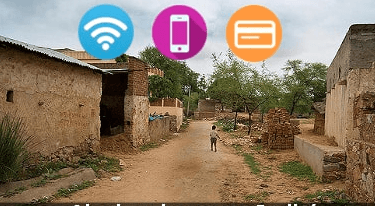
First digital village in India
Author : adminPublished : February 27, 2026
In early 2016, when most of rural India was still dependent on cash transactions, a small village in Gujarat quietly rewrote the rules. In Akodara, buying milk, paying at the kirana store, settling farm dues, or even contributing to community activities no longer required physical currency. Every transaction could be completed with a digital swipe or mobile tap.
Located in Sabarkantha district of Gujarat, Akodara earned national recognition as India’s first digital village—a distinction formally conferred in January 2016 under the Digital Village Initiative led by ICICI Bank, and inaugurated by Prime Minister Narendra Modi himself. What made Akodara remarkable was not just the technology, but the scale of adoption: every household in the village was brought into the formal digital banking system.
This was not a pilot confined to a few shops or a symbolic experiment. Akodara demonstrated a fully functional cashless rural economy, covering daily essentials, agriculture, education, and governance. Importantly, the transformation relied on training, trust-building, and local participation, rather than top-down enforcement.
This article examines how Akodara became India’s first digital village, the systems that sustained it, the measurable outcomes of the initiative, and why Akodara remains a reference point for Digital India nearly a decade later. The analysis draws on official ICICI documentation, government records, and census data, ensuring accuracy and transparency throughout.
| population of Gujarat | literacy rate of Gujarat | sex ratio of Gujarat |

2. Location & Village Profile
2.1 Geographic and Administrative Setting
Akodara is situated in Sabarkantha district, a largely agrarian region in northern Gujarat. Administratively, it falls under the Bayad–Modasa belt, approximately 90 km from Ahmedabad and well connected to district headquarters such as Himatnagar. Despite its proximity to urban centres, Akodara retained a typical rural character prior to 2016.
2.2 Demographic Snapshot
At the time of the digital transformation, Akodara had a population of approximately 1,190 residents across 260 households. The village economy was primarily dependent on agriculture, with wheat, cotton, and mustard as major crops. Literacy levels were moderate to high by rural standards, creating a favourable base for digital training.
| Indicator | Approximate Value |
| Population | ~1,190 |
| Households | ~260 |
| Main occupation | Agriculture |
| Literacy (approx.) | ~75% |
2.3 Life Before Digitisation
Before 2016, Akodara functioned like thousands of other Indian villages:
- Banking access existed, but was underutilised
- Cash dominated all transactions
- Digital literacy was minimal
- Women’s participation in formal finance was limited
The village was neither especially affluent nor particularly backward—making it an ideal test case for a scalable digital rural model.
3. The Digital Transformation Journey
3.1 Launch and National Spotlight
On January 27, 2016, Akodara entered India’s digital history books. Prime Minister Narendra Modi and then ICICI Bank Managing Director Chanda Kochhar formally launched the project, handing over digital payment devices to the village leadership. Akodara was declared the first of 100 digital villages ICICI planned to develop nationwide.
The symbolism was powerful: Digital India was no longer an urban vision—it had arrived in a village.
3.2 Phased Implementation Strategy
Rather than an overnight switch, Akodara’s digitisation followed a phased and inclusive approach:
Phase 1: Digital Literacy & Trust Building
- Door-to-door financial literacy camps
- Hands-on training for all households
- Special focus on elderly residents and women
Phase 2: Infrastructure Deployment
- POS machines at milk cooperative, kirana stores, and agri markets
- Mobile banking access in Gujarati, Hindi, and English
- Free or subsidised smartphones for women’s Self-Help Groups
Phase 3: Full Go-Live
By March 2016, Akodara achieved near-universal digital transaction usage, effectively becoming cashless for daily needs.
4. Digital Features: How Akodara Went Cashless

4.1 Core Digital Infrastructure
Akodara’s transformation was supported by a carefully designed ecosystem:
| Digital Feature | Implementation |
| Mobile Banking | ICICI iMobile app (Gujarati enabled) |
| POS Payments | Milk co-op, kirana, mandi |
| Village Website | Local information & services portal |
| Digital Education | Smart boards, tablets in schools |
| Power Support | Community solar panels |
Every key transaction point in village life—food, milk, farming, education—was digitised.
4.2 Impact on Daily Transactions
- Milk farmers received daily payments digitally, even for amounts as small as ₹20–₹50
- Agricultural sales at mandis shifted to POS-based settlements
- Household purchases moved from cash to card and mobile payments
4.3 Women and Financial Inclusion
One of the most significant outcomes was women’s empowerment. Self-Help Groups managed bank accounts independently, tracked savings digitally, and conducted transactions without intermediaries. For many women, Akodara marked their first direct interaction with formal finance.
5. Success Metrics & Recognition
5.1 Measurable Outcomes
According to ICICI and government reports:
- ₹50 lakh+ worth of digital transactions recorded in the first year
- 100% household banking coverage
- Improved school attendance after introduction of digital classrooms
- Zero rollback to cash-only systems
5.2 National and Institutional Recognition
Akodara received:
- Digital India Award from Government of India
- Recognition by RBI as a reference model
- Coverage in national and international media
5.3 Challenges and Solutions
Initial resistance—especially among senior citizens—was addressed through continuous hand-holding, not enforcement. Connectivity challenges were later resolved with the expansion of 4G services, ensuring long-term viability.
6. Akodara as a Digital India Pioneer
6.1 Akodara in the National Digital India Context
When the Government of India launched the Digital India programme in 2015, its vision rested on three pillars: digital infrastructure as a utility, digital delivery of services, and digital empowerment of citizens. Akodara became the first rural settlement in India to demonstrate all three pillars in action simultaneously.
Unlike urban digitalisation, where technology adoption is driven by convenience and commercial incentives, Akodara’s success lay in institutional trust and community participation. The village showed that digital systems could work even where:
- Literacy levels were uneven
- Smartphone ownership was initially low
- Cash had been the default for generations
By achieving 100% banking inclusion and near-universal digital transactions, Akodara served as a proof-of-concept village for policymakers, banks, and regulators. Its experience directly influenced later rural digitisation initiatives under Jan Dhan–Aadhaar–Mobile (JAM) trinity and the nationwide UPI ecosystem.
6.2 Replication and Policy Influence
Following Akodara’s success:
- ICICI Bank expanded the Digital Village model to 99 more villages across India
- Other banks and state governments adopted similar frameworks
- The Reserve Bank of India cited Akodara in discussions on rural digital payments
What made Akodara replicable was its low-cost, high-impact design. With an estimated investment of around ₹50 lakh, the village demonstrated that rural digitisation did not require massive infrastructure—only training, connectivity, and institutional coordination.
7. Current Status and the Road Ahead

7.1 Akodara a Decade Later (2025–26 Snapshot)
Nearly ten years after its launch, Akodara has not reverted to cash dependency. Instead, it has evolved with India’s digital ecosystem. Cashless card payments have gradually given way to UPI-based transactions, Aadhaar-linked services, and mobile-first banking.
Key updates include:
- UPI and QR-code payments replacing POS dominance
- Solar-powered ATM and service kiosks
- Integration with digital health camps and telemedicine pilots
- E-commerce experiments for direct farm-to-market sales
Population has grown modestly to an estimated 1,400+ residents, yet digital adoption remains high—indicating behavioural permanence, not a temporary experiment.
7.2 Lessons for Rural India
Akodara offers clear takeaways for India’s 600,000+ villages:
- Digital literacy matters more than devices
- Local leadership accelerates adoption
- CSR–government partnerships are scalable
- Trust precedes technology
The Akodara model proves that rural digital inclusion is not aspirational—it is achievable, even in small agricultural communities.
8. Visiting Akodara: Seeing Digital India on the Ground
8.1 How to Reach
Akodara is easily accessible:
- Ahmedabad → Himatnagar (road or rail)
- Himatnagar → Akodara by local road
The village is within a comfortable day trip radius from Ahmedabad.
8.2 What to See
Visitors interested in rural digital transformation can observe:
- Digitally operated milk cooperative
- Smart classrooms in village schools
- Demonstrations of UPI payments in everyday shops
- Village information portal and community facilities
8.3 Responsible Engagement
Akodara is not a tourist attraction in the conventional sense. Visitors—especially researchers, students, and policymakers—are encouraged to:
- Seek prior permission from local authorities
- Engage respectfully with residents
- Support local businesses through digital payments, reinforcing the village’s digital economy
9. Conclusion: A Blueprint for 600,000 Villages
Akodara’s journey from a cash-dependent agricultural village to India’s first fully digital village stands as one of the most credible success stories of Digital India. It proved that technology, when paired with training and trust, can bridge the urban–rural divide without disrupting social structures.
Nearly a decade later, Akodara remains relevant—not as a museum piece of early digitisation, but as a living, evolving digital ecosystem. Its legacy lies not just in being first, but in being sustainable.
As India moves toward a trillion-dollar digital economy, Akodara serves as a quiet reminder that the future of innovation does not begin in cities alone—it can begin in a village of 1,200 farmers who chose to swipe instead of count cash.
Latest Post
 City Of Peace In India
9/14/2026
 Highest Tax Paying City In India
9/13/2026
 City Of Light In India
9/12/2026
 City Of Hills In India
9/11/2026
 City of Gods in India
9/10/2026