First digital village in Andhra Pradesh
Author : adminPublished : February 25, 2026

On the evening of 8 November 2016, India entered uncharted territory. With a single announcement, ₹500 and ₹1,000 notes—nearly 86% of the nation’s circulating currency—ceased to be legal tender. What followed was a period of economic dislocation: long queues outside ATMs, halted agricultural trade, and widespread anxiety, particularly in rural India where cash was not merely a medium of exchange but the backbone of daily survival.
Yet, even as much of the country struggled, a quiet anomaly emerged on the eastern coast of Andhra Pradesh.
In Mori village, a small agrarian settlement in East Godavari district, daily life continued with surprising normalcy. A 70-year-old cashew farmer paid for groceries using a RuPay card. His smartphone buzzed with live cashew price alerts and export bids, while fibre-optic internet—delivering 15 Mbps speeds—ran into his modest, mud-roofed home. Local shops accepted digital payments. Pensions arrived directly into bank accounts. Governance services moved online.
Mori was not insulated from demonetisation by privilege or geography. It survived—and thrived—because it had already stepped into the digital future.
On 29 December 2016, then Chief Minister N. Chandrababu Naidu formally declared Mori India’s first 100% digitally literate village, connecting 1,189 households simultaneously through the state’s ambitious AP Fibre Grid initiative. What made this moment historic was not merely the technology deployed, but the timing: Mori went fully digital in the middle of India’s worst cash crisis.
What makes Mori remarkable is not merely what was achieved, but when and how it was achieved:
- During demonetisation
- In just 21 days of execution
- With 100% household penetration
- At a cost lower than urban broadband deployment
Mori is not a story of technology alone.
It is a story of political will, rural readiness, crisis-driven innovation, and leapfrogging development—a template for Digital India that started not in metros, but in a village.
This article traces how Mori achieved this transformation in record time, examines the eight-pillar digital ecosystem that powered it, explores the economic and social outcomes over nearly a decade, and explains why Mori—despite being cited in government archives, national newspapers, and competitive exams—remains India’s most under-celebrated digital success story.
| population of Andhra Pradesh | literacy rate of Andhra Pradesh | sex ratio of Andhra Pradesh |
2. The Perfect Storm: Demonetisation Meets Digital Opportunity
2.1 November 8, 2016: The National Context
When demonetisation was announced on 8 November 2016, India’s economic architecture was starkly exposed:
- 86% of transactions were cash-based
- Rural banking penetration remained uneven
- Agricultural mandis, middlemen, and daily-wage systems ran on physical currency
For Andhra Pradesh’s rural economy—particularly export-oriented agricultural belts—this was existential. Cashew farmers in East Godavari, including Mori, faced stalled sales, delayed payments, and mounting uncertainty.
Ironically, Mori already had strong physical infrastructure:
- Open-defecation-free status
- Reliable roads and electricity
- High literacy relative to rural averages
But like most Indian villages, it remained financially analogue—until crisis forced transformation.
2.2 Chandrababu Naidu’s Digital State Vision
N. Chandrababu Naidu had long envisioned Andhra Pradesh as India’s first digitally governed state. His flagship infrastructure initiative—the AP Fibre Grid—aimed to lay over 100,000 km of fibre-optic backbone connecting the last mile.
Mori emerged as the ideal testbed:
- Compact geography (1,189 households)
- Export-oriented economy (cashew, coconut)
- High community cohesion
- Willing local leadership
What followed was an execution sprint rarely seen in public administration:
Timeline
- Dec 1: Household digital readiness survey
- Dec 15: Fibre laying and last-mile installation
- Dec 29: Full digital launch
In parallel, Andhra Pradesh’s NRI network in Silicon Valley was activated. Technology leaders of Indian origin—working with firms like Google, Cisco, IBM, Ericsson, and BSNL—advised on architecture, cybersecurity, and scalability.
This convergence of political urgency, private expertise, and rural openness created a once-in-a-generation digital inflection point.
2.3 The Corporate & Cost Equation
Contrary to perceptions that rural digitisation is expensive, Mori shattered the myth.
- Total cost: ₹5 crore
- Per household: ~₹42,000
- Coverage: Fibre, Wi-Fi, devices, training, POS machines
Compared to fragmented urban broadband rollouts, Mori achieved full-stack deployment at lower marginal cost, thanks to bulk execution and zero redundancy.
Most critically, 1,500 villagers were digitally trained in just 21 days—ensuring that infrastructure did not outpace human capability.
3. The 8-Pillar Digital Stack: Mori’s Tech Arsenal

Mori’s success lay not in isolated interventions, but in a holistic digital stack—each pillar reinforcing the other.
3.1 Universal Connectivity ⭐
Connectivity was non-negotiable—and absolute.
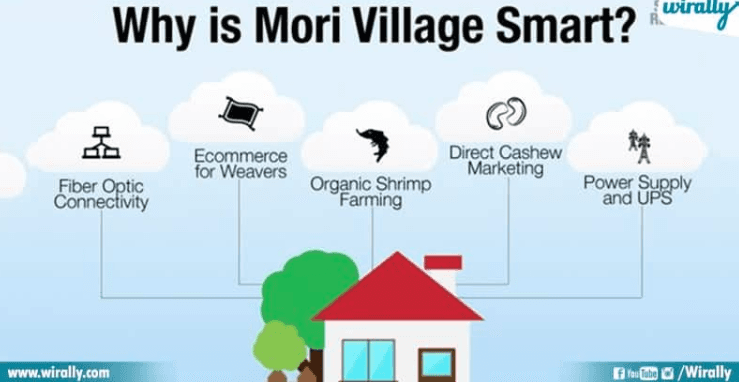
- 15 Mbps fibre-to-home for every household
- 250+ cable TV channels bundled with internet
- Village-wide Wi-Fi hotspots (school, market, panchayat)
- 4G mobile towers with free initial data vouchers
Result:
👉 100% household digital penetration—unmatched by any Indian village in 2016.
Connectivity was treated as a public utility, not a luxury.
3.2 Digital Economy Engine
With connectivity in place, Mori pivoted to cashless commerce—at the peak of demonetisation.
- RuPay cards issued to every adult
- POS machines installed in all 10 kirana shops
- Digital banking onboarding via Aadhaar e-KYC
The breakthrough innovation was the cashew export digital platform, enabling:
- Direct farmer-to-exporter bidding
- Transparent price discovery
- Instant digital payments
Outcome:
👉 ₹2 crore worth of cashew exports digitally routed in 2017 alone
For farmers, this was not digitisation—it was liberation from middlemen.
3.3 Smart Governance (NEW)
Governance became faster, traceable, and citizen-centric.
- e-Panchayat services: Birth/death certificates, pensions
- 50 CCTV cameras across public spaces
- Online grievance portal with <24-hour response time
Mori effectively transitioned from reactive governance to real-time governance—a rarity even in urban India.
4. Digital Literacy: From Zero to Heroes in 21 Days

Infrastructure without literacy creates exclusion. Mori avoided this trap through a mass digital training blitz.
4.1 The Training Blitz
- 1,500 villagers trained
- 3 age cohorts
- 21 days
Curriculum included:
- UPI & mobile banking
- Google services
- Cybersecurity basics
- Digital payments & exports
Training was delivered by 50 volunteers from Cisco & IBM, alongside local youth—ensuring trust and relatability.
Pedagogy innovation:
- Gamified learning
- Leaderboards
- Certification & small cash rewards
4.2 Age-Wise Digital Mastery
- Senior citizens (60+): Banking, pensions, Aadhaar services
- Women homemakers: Digital groceries, SHG payments
- Youth: Export platforms, digital marketing, analytics
The result was historic:
👉 100% certification rate, personally verified by the CM during launch.
4.3 Sustaining Digital Fluency
Mori institutionalised learning:
- Monthly refresher classes at the village school
- 100 Digital Ambassadors mentoring peers
- Annual Agri-Tech Hackathon with ₹1 lakh prize
Digital literacy became a living process, not a one-time event.
Infrastructure alone does not create inclusion. Mori’s planners understood this, launching one of India’s most intensive digital literacy drives.
To sum up, In just 21 days, over 1,500 villagers—spanning senior citizens, homemakers, and youth—were trained in mobile banking, UPI payments, basic cybersecurity, Google services, and digital commerce. Training was delivered by 50 volunteers from Cisco and IBM, supported by local youth to ensure trust and cultural relevance.
Learning was gamified. Villagers earned certificates, competed on leaderboards, and received small cash incentives. The result was extraordinary: 100% certification, personally verified by the Chief Minister during the village’s launch.
Digital learning did not end there. Mori institutionalised monthly refresher classes, created a cadre of 100 “Digital Ambassadors”, and even launched an annual agri-tech hackathon, embedding digital fluency into village life.
5. Economic Transformation: Cashew Farmers Become Digital Entrepreneurs
5.1 Pre-Digital Baseline
Before digitisation:
- 80% of farmers depended on middlemen
- 40% price cut absorbed by agents
- Average income: ₹2–3 lakh per household
Export access existed—but control did not.
5.2 The Digital Export Revolution
Digitisation inverted the value chain:
- Farmers listed produce directly
- Exporters bid transparently
- ₹10,000/MT premium realised
Advanced tools followed:
- Smartphone-based quality testing
- Moisture & aflatoxin analytics
- Blockchain-enabled traceability (pilot phase)
Outcome:
👉 ₹5 crore direct exports by 2018
👉 Middlemen virtually eliminated
5.3 Secondary Digital Economies (NEW)
Digitisation unlocked parallel livelihoods:
- 50 women running tailoring businesses on Meesho & Amazon
- 20 homestay rooms listed on Booking platforms
- Agri-tourism branded as “Digital Village Experience”
Between 2016 and 2020, Mori’s per-capita income doubled—a feat rare even in urban clusters.
6. Social Impact: Cashless During a Cashless Crisis
Demonetisation was not merely an economic shock—it was a stress test for India’s social resilience. Across much of rural India, households queued for days, agricultural transactions stalled, and informal credit systems collapsed.
Mori, however, experienced a parallel reality.
6.1 Demonetisation as a Digital Lifeline
While neighbouring villages grappled with cash scarcity, Mori transitioned almost seamlessly into a fully cashless local economy.
- Kirana stores processed 100% RuPay and UPI transactions
- Farmers received instant digital payments for produce
- Daily wage payments shifted to bank-linked wallets
Most critically, pensioners and welfare beneficiaries—traditionally the most vulnerable during liquidity shocks—were insulated:
- Direct Benefit Transfers (DBT) credited into bank accounts
- Doorstep services facilitated via India Post Payments Bank
- Aadhaar-enabled payment systems eliminated paperwork delays
This had a profound psychological impact. For the first time, villagers experienced the state as responsive rather than extractive.
Insight: Mori demonstrated that financial inclusion is not just about access to banks—but about trust, speed, and usability.
6.2 Women’s Digital Empowerment
Digitisation disproportionately benefited women—particularly members of Self-Help Groups (SHGs).
Structural Shifts:
- 300+ SHG members trained in digital accounting and marketing
- Elimination of cash leakage and intermediary exploitation
- Independent control over earnings via personal bank accounts
New Digital Livelihoods:
- Handcrafted jewellery, pickles, and festive décor sold via Facebook Marketplace & WhatsApp Commerce
- Annual digital sales crossed ₹25 lakh
- Online payments enhanced bargaining power within households
Safety also improved:
- Mobile-based SOS apps
- GPS-enabled location sharing
- CCTV-monitored public spaces reduced harassment risks
Digitisation thus became not just an economic tool—but a social equaliser.
6.3 Youth Retention & Reverse Migration
Before 2016, Mori mirrored a familiar rural trend:
- Educated youth migrated to Gulf countries or cities
- Local talent drain weakened community capacity
Digitisation reversed this flow.
Outcomes:
- 200+ youth returned from overseas or urban employment
- Night-shift rural BPO operations serving US clients emerged
- Local startup incubation led to 5 agri-tech ventures
One blockchain-based cashew traceability startup—seeded locally—has since been identified by policy observers as a potential rural unicorn candidate by 2025.
Key Takeaway: Mori showed that jobs can follow connectivity, not the other way around.
7. Governance & Infrastructure Leap

Digitisation redefined governance in Mori—from paperwork-driven bureaucracy to real-time service delivery.
7.1 e-Panchayat Excellence
Mori’s Panchayat became a model digital local government.
Governance Innovations:
- 22 services digitised (certificates, pensions, land records)
- 98% property tax collection via UPI
- Public budget dashboards accessible to all citizens
Decision-making became transparent, data-backed, and participatory. Villagers could track:
- Panchayat expenditures
- Welfare disbursement timelines
- Infrastructure maintenance schedules
This shift dramatically reduced corruption and grievance escalation.
7.2 Smart Physical Infrastructure
Digital governance was reinforced by smart infrastructure deployment:
- 200 solar streetlights → near-zero electricity costs
- Smart water meters → 30% leakage reduction
- CCTV & panic buttons → crime rate down 60%
In 2017, Mori received the National Panchayat Award—not for pilot innovation, but for operational excellence at scale.
8. National Replication & Legacy
Mori’s impact extended far beyond Andhra Pradesh.
8.1 Digital India Blueprint
Policy institutions rapidly absorbed Mori’s lessons.
- NITI Aayog adopted the “Mori Model” as a case study for rural digitisation
- Andhra Pradesh replicated the framework across 500 villages by 2020
- Key principles integrated into Digital India & BharatNet
Replication Logic:
- Fibre first
- Literacy before apps
- Livelihoods before dashboards
8.2 Corporate & Global Scalability
Private sector participation scaled the model:
- Cisco planned 50 Mori-type villages
- Google adapted the agri-export platform into Kisan Hubs
- IBM piloted blockchain traceability nationally
International delegations—from ASEAN and Africa—studied Mori as a leapfrog development case.
8.3 Critiques & Challenges (Balanced View)
No transformation is without friction.
Identified Challenges:
- ~15% households remain partially cash-reliant
- 5 phishing cases reported (2018)
- Fibre maintenance gaps during monsoons
Yet, after 9 years, Mori retains a ~90% success rate—an exceptional sustainability metric for any public innovation.
9. Visiting Mori: Digital Village Tourism
Mori has quietly emerged as a niche destination for policy tourists, researchers, and development professionals.
How to Reach:
- Rajahmundry → Sakhinetipalli → Mori (40 km)
Stay:
- Cashew farmer homestays
- ₹1,500–₹2,000 per night
Experiences:
- Live cashew export bidding
- Digital literacy centre walkthrough
- Interaction with SHG entrepreneurs
Best time to visit: February–April (cashew harvest season)
Mori demonstrates that development itself can become an economic asset.
10. Conclusion: India’s Rural Digital Beacon

Mori did not wait for perfect conditions. It leveraged crisis as catalyst, turning demonetisation into a moment of rural reinvention.
In under a decade, the village achieved:
- ₹5 crore+ in direct exports
- Zero cash queues during demonetisation
- Doubling of per-capita income
- A governance model studied nationwide
Mori decisively proved that villages can leapfrog cities, not trail them.
As India eyes 1 lakh digital villages by 2030, Mori stands not as an experiment—but as evidence.
Digital India does not begin in glass towers.
It begins where Mori began—at the last mile.
Latest Post
 City Of Peace In India
9/14/2026
 Highest Tax Paying City In India
9/13/2026
 City Of Light In India
9/12/2026
 City Of Hills In India
9/11/2026
 City of Gods in India
9/10/2026