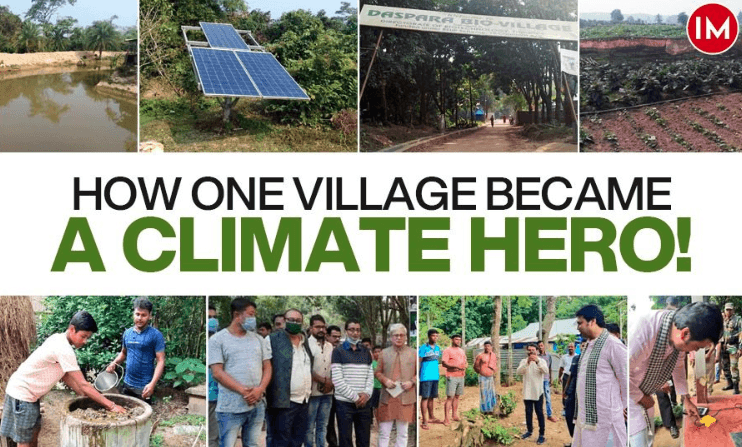
First bio village in India
Author : adminPublished : February 28, 2026
In an era when climate change, rising fuel costs, and chemical-heavy agriculture dominate conversations about rural distress, Daspara, a small village in Tripura, quietly rewrote the script. Here, cooking gas flows not from LPG cylinders but from biogas plants fed by cow dung. Fields flourish without chemical fertilizers. Electricity for irrigation comes from solar panels, not diesel pumps. What makes Daspara exceptional is not a single innovation, but the complete integration of ecology, economy, and everyday life.
Recognised as India’s first fully self-sustaining Bio Village, Daspara emerged under Tripura’s Bio Village 2.0 initiative around 2018. With just 64 households, this village eliminated dependence on external energy, reduced farming costs, increased household income, and created a closed-loop system where waste became wealth. Each family now saves thousands of rupees annually on fuel and fertilizers while earning premium prices for organic produce, especially pineapple.
Unlike many sustainability projects that remain pilots or collapse after funding ends, Daspara stands out because of measurable outcomes: over 100% income growth, complete elimination of chemical inputs, and a significant reduction in carbon emissions. The project was not NGO-driven symbolism but a government-led, technically monitored, community-owned transformation, guided by IAS leadership and implemented through Tripura’s Biotechnology Directorate.
This article explores how Daspara became India’s first Bio Village, examining its location, policy genesis, technical systems, economic impact, and social transformation. More importantly, it explains why Daspara is not just a rural success story, but a scalable blueprint for climate-resilient villages across India.
| population of Tripura | literacy rate of Tripura | sex ratio of Tripura |

2. Location Deep Dive: Northeast India’s Green Frontier
Geographic and Administrative Setting
Daspara is located in Sepahijala district of Tripura, one of India’s smallest but most forest-rich states. Administratively, the village falls under Bishalgarh block and the Charilam Assembly Constituency, situated roughly 25 kilometres from Agartala, the state capital. This proximity to the capital city proved crucial for regular monitoring, technical support, and policy visibility.
Tripura itself provides a unique ecological context for a bio-village experiment. With over 70% forest cover, abundant rainfall, and a long tradition of smallholder farming, the state is naturally suited for organic and low-input agriculture. Daspara sits in a fertile belt known for pineapple and paddy cultivation, with warm temperatures and nutrient-rich soils that respond well to organic inputs.
Village Profile Before Bio Village Transformation
Before its transformation, Daspara resembled a typical rural Tripura settlement:
- Agriculture-dependent economy, primarily paddy and pineapple
- Heavy reliance on chemical fertilizers supplied through government channels
- Monthly LPG expenses averaging ₹700–₹900 per household
- Erratic electricity supply affecting irrigation and storage
- Women involved in Self-Help Groups, but largely confined to low-income activities
Despite these challenges, Daspara had two advantages that made it an ideal pilot:
a compact size (64 households) and a high level of community cohesion. These factors reduced coordination costs and enabled faster adoption of new practices.
Why Daspara Mattered Regionally
Tripura’s economy is heavily rural, with over 85% of its population living in villages. Any scalable sustainability solution had to work under real rural constraints — small landholdings, limited capital, and dependence on government support. Daspara became the testing ground for Tripura’s ambition to position itself as a leader in organic agriculture and green energy, aligned with India’s broader climate commitments and the Northeast’s strategic importance under the Act East Policy.
3. Bio Village 2.0 Genesis: From Policy Vision to Pilot Village

The Policy Backdrop
The idea of bio villages in Tripura did not emerge overnight. It evolved from the state’s long-standing focus on biotechnology-driven rural development. In 2015, Tripura launched its Bio-Resource Development Programme, aimed at linking agriculture, renewable energy, and livelihoods.
By 2018, the state moved beyond fragmented interventions and conceptualised Bio Village 2.0 — a model village that would be:
- Energy self-sufficient
- 100% organic
- Economically profitable
- Environmentally regenerative
Daspara was selected as the flagship pilot.
Leadership and Implementation
A defining factor behind Daspara’s success was administrative ownership. The project was spearheaded by IAS officer Siddharth Shiv Jaiswal, who ensured that Daspara did not remain a symbolic showcase. Instead, it became a monitored, outcome-oriented programme with clear timelines and accountability.
Key implementing agencies included:
- Tripura Biotechnology Directorate – technical design and funding
- Tripura Renewable Energy Development Agency (TREDA) – solar and biogas systems
- Local Panchayat leadership – mobilisation and conflict resolution
Rather than outsourcing implementation entirely, government engineers and extension workers were embedded in the village during the critical initial months.
Why Daspara Was Chosen
Daspara met all selection criteria for Bio Village 2.0:
- Manageable scale (64 households)
- Existing farming base with pineapple as a high-value crop
- Active women’s Self-Help Groups
- Road connectivity to Agartala for logistics and oversight
By 2020, Daspara was officially recognised as India’s first Bio Village, marking the transition from policy experiment to national case study.
4. Technical Blueprint: Eight Integrated Bio Systems
Daspara’s transformation was not driven by a single technology but by eight interlinked systems, designed to reinforce one another.
Energy Independence Through Biogas and Solar
Every household received a 2 cubic metre biogas plant, converting cow dung into clean cooking fuel. This eliminated LPG usage entirely. The slurry by-product was channelled back into fields as high-quality organic manure, completing a nutrient loop.
For irrigation, a community solar array powered water pumps, replacing diesel and grid electricity. Improved smokeless chulhas reduced indoor air pollution and fuel consumption by nearly 30%.
Organic Farming Architecture
Chemical inputs were replaced with:
- Vermicompost
- Bio-pesticides (neem, Trichoderma)
- Green mulching using pineapple waste
Pineapple yields increased from around 20 tonnes per acre to nearly 25 tonnes, while gaining access to premium organic markets.
Waste-to-Wealth Loop
Kitchen waste fed compost pits. Livestock waste powered biogas. Crop residues became mulch and feed. Nothing left the system as “waste”.
Each household received a ₹2.5 lakh infrastructure package, with nearly 90% subsidy, ensuring affordability and long-term adoption.
5. Economic Transformation: From Subsistence to Surplus
The most powerful validation of Daspara’s bio village model lies in its economic outcomes.
Before the intervention, households earned roughly ₹1.5 lakh per year, with high input costs and low price realisation. Post-transformation, average annual household income rose to over ₹3.1 lakh, representing a 109% increase.
Key drivers included:
- Energy savings of ~₹60,000 per year per household
- Premium pricing for organic pineapple (25–40% higher)
- Increased livestock productivity
- Women-led micro-enterprises under SHGs
Daspara’s produce achieved NPOP organic certification, opening doors to institutional buyers and export-linked value chains. For the first time, farming families experienced predictable income and surplus savings.
6. Social Impact: Women and Youth at the Core

Women as Change Leaders
Women’s Self-Help Groups moved from marginal activities to the centre of the bio-village economy. Members were trained as:
- Biogas technicians
- Organic input producers
- Value-addition entrepreneurs (pineapple juice, pickles)
Many women now earn ₹6,000–₹10,000 per month, independent of agriculture cycles.
Youth Migration Reversal
Daspara also witnessed a rare phenomenon: reverse migration. Young men who had moved to Agartala for low-paying jobs returned to manage solar systems, farms, and organic enterprises.
Children grew up learning sustainability not from textbooks, but from daily life — maintaining biogas plants, compost pits, and organic fields.
7. Environmental Metrics: Daspara as a Climate Action Village
Beyond income gains and energy savings, Daspara’s most far-reaching impact lies in its measurable environmental outcomes. Unlike symbolic “green villages,” Daspara’s transformation has been documented through quantifiable ecological indicators, making it a credible climate-action case study rather than a feel-good anecdote.
Carbon Emission Reduction
The replacement of LPG cylinders and firewood with household biogas plants resulted in a substantial reduction in greenhouse gas emissions. Across 64 households, the village cuts an estimated 28 tonnes of CO₂ equivalent per year, primarily from avoided fossil fuel combustion and reduced black carbon emissions.
Improved smokeless chulhas further lowered indoor air pollution, reducing black carbon — a short-lived but highly potent climate pollutant — by approximately 1.2 tonnes annually. This has direct health benefits, particularly for women and children, who are most exposed to cooking smoke in rural households.
Elimination of Chemical Inputs
Daspara completely eliminated the use of chemical fertilizers and pesticides, cutting an estimated 12 tonnes of synthetic agro-chemicals per year from entering soil and water systems. This shift significantly reduced nitrate leaching into groundwater and helped restore soil microbial life.
Soil tests conducted after the transition showed:
- Threefold increase in beneficial soil microbes
- Fivefold increase in earthworm populations
- Improved soil structure and moisture retention
Biodiversity Revival
Farmers reported the return of pollinators, birds, and beneficial insects that had largely disappeared during the chemical farming era. Field observations recorded at least 15 new bird species in and around pineapple fields, attributed to pesticide elimination and diversified cropping.
These outcomes earned Daspara recognition in national climate documentation, including inclusion in India’s Compendium of Best Climate Practices, positioning the village as a living example of grassroots climate mitigation and adaptation.
8. Challenges & Solutions: What It Took to Make Bio Village 2.0 Work
Daspara’s success was neither instant nor effortless. Its journey highlights the practical challenges of implementing sustainability at the village scale — and the solutions that made long-term adoption possible.
Initial Resistance and Cultural Barriers
The first major hurdle was behavioural resistance. Many households were sceptical of abandoning LPG for biogas, fearing inconvenience, hygiene issues, and system failure. Similarly, farmers worried that organic farming would reduce yields.
Solution:
Instead of imposing rules, the administration implemented a six-month demonstration phase, allowing farmers to see yield results firsthand. Early adopters became ambassadors, persuading others through lived experience rather than instruction.
Technical Reliability
Biogas plants and solar systems initially faced maintenance issues, especially during the first monsoon season.
Solution:
Engineers from TREDA were stationed in the village for three months. More importantly, local youth and women were trained as technicians, ensuring immediate troubleshooting without dependence on external agencies.
Financial Concerns
Although long-term savings were clear, upfront costs posed a psychological barrier.
Solution:
A 90% subsidy model, combined with a revolving village maintenance fund, ensured affordability while preserving community ownership. Households contributed modest amounts, reinforcing responsibility rather than entitlement.
Market Skepticism for Organic Produce
Traders were initially unwilling to pay premiums for organic pineapple.
Solution:
Certification under the National Programme for Organic Production (NPOP) and direct linkages with institutional buyers bypassed local middlemen, securing premium prices.
The critical success factors were strong administrative ownership, compact scale, women-led leadership, and a high-value anchor crop. Daspara succeeded because policy, people, and profitability aligned.
9. National & Global Context: Where Daspara Stands
Position in India’s Sustainability Landscape
Daspara occupies a unique place in India’s rural development history. While villages like Ralegaon Siddhi pioneered water conservation and Sikkim achieved state-wide organic status, Daspara represents the first fully integrated bio-village at the household level, combining:
- Renewable energy
- Organic agriculture
- Waste recycling
- Women-led enterprises
- Income growth
It differs from earlier models by being government-led yet community-owned, making it replicable within India’s administrative framework.
Comparison with Global Eco-Villages
Globally known eco-villages such as Auroville (India) or Findhorn (Scotland) are often spiritual or lifestyle-driven, catering to niche populations. Daspara’s distinction lies in its scalability — it is designed for ordinary farming households, not alternative communities.
Daspara demonstrates that climate-positive rural living is achievable without sacrificing income or cultural continuity, a lesson increasingly relevant as nations seek scalable sustainability solutions.
10. Visiting Daspara & Ethical Rural Tourism
Daspara is gradually emerging as a learning destination, attracting policymakers, researchers, students, and sustainability practitioners rather than mass tourists.
How to Reach
- Agartala → Bishalgarh → Daspara (approximately 45 minutes by road)
- Nearest airport: Agartala Airport
- Best season: October to March, coinciding with pineapple harvest
What Visitors Can Experience
- Live demonstration of household biogas plants
- Organic pineapple fields and vermicompost pits
- Women-run SHG enterprises producing value-added goods
- Community discussions on bio-village governance
Ethical Guidelines
Visitors are encouraged to:
- Purchase local organic produce
- Avoid intrusive photography inside homes
- Respect farm work schedules
- Contribute to the village maintenance fund
Daspara is not a spectacle; it is a working village, and responsible engagement is essential to preserve dignity and sustainability.
11. Conclusion: Daspara as a Blueprint for Climate-Resilient India
Daspara’s journey from a conventional farming village to India’s first fully functional Bio Village offers a powerful lesson: sustainability succeeds when it improves lives, not when it demands sacrifice. By doubling incomes, cutting emissions, empowering women, and restoring ecological balance, Daspara proves that rural India can lead the climate transition rather than lag behind it.
Its greatest contribution lies in demonstrating that bio-villages are not idealistic experiments, but practical, government-scalable solutions. With over 600,000 villages facing rising energy costs, soil degradation, and climate uncertainty, Daspara provides a tested, replicable model rooted in Indian realities.
As India moves toward its climate commitments and rural transformation goals under Amrit Bharat, Daspara stands as evidence that the path forward is not only digital or industrial — it is also biological, local, and regenerative.
In the story of India’s village extremes, Daspara represents the extreme of hope — a reminder that the most sustainable futures may begin in the smallest villages.
Latest Post
 City Of Peace In India
9/14/2026
 Highest Tax Paying City In India
9/13/2026
 City Of Light In India
9/12/2026
 City Of Hills In India
9/11/2026
 City of Gods in India
9/10/2026