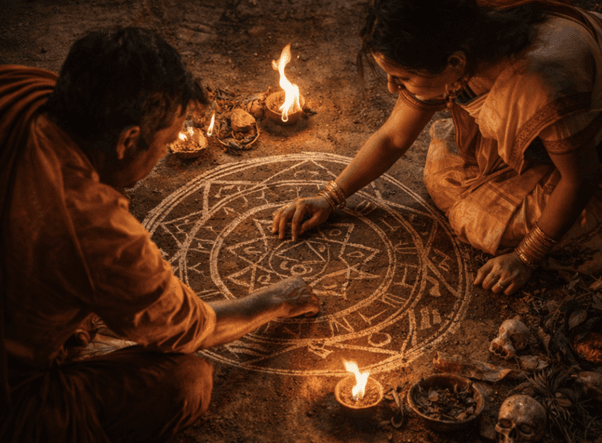
Black Magic Village In Assam
Author : adminPublished : January 13, 2026
Nestled in the heart of Assam lies Mayong, a small rural village that has earned an extraordinary reputation across India and beyond. Often referred to as the “Black Magic Capital of India” or the “Land of the Occult,” Mayong has long fascinated travellers, journalists, anthropologists, and storytellers. Unlike fictional haunted towns, Mayong is a living village—inhabited, cultivated, and culturally active—yet surrounded by stories of tantra, sorcery, mantras, and supernatural powers that blur the boundary between belief and history.
For centuries, Mayong’s name has been associated with mysterious practices ranging from faith healing and mantra-based rituals to tales of shape-shifting, disappearance, and mind control. Colonial writers described it with a mix of fear and curiosity, while modern media often presents it as a place frozen in occult secrecy. These portrayals, however, rarely capture the full reality of Mayong.
Today, Mayong stands at the intersection of folklore, anthropology, and popular culture. While its reputation as a “black magic village” continues to draw attention, locals increasingly emphasise that the village’s traditions are deeply rooted in indigenous knowledge systems, folk medicine, and spiritual practices, rather than sinister witchcraft.
Understanding Mayong requires nuance. This article explores where Mayong is located, how its occult reputation emerged, what practices are actually associated with it, and how myths, media, and modern tourism have shaped its image, while clearly separating belief from evidence.
| population of Assam | literacy rate of Assam | sex ratio of Assam |
2. Where Is Mayong?
Mayong is located in the Morigaon district of Assam, approximately 40–45 kilometres from Guwahati, the largest city in Northeast India. The village lies along the southern banks of the Brahmaputra River, one of India’s most powerful and culturally significant waterways. Its location places it close to the Pobitora Wildlife Sanctuary, a well-known habitat for the one-horned rhinoceros.
Geography and Landscape
The physical setting of Mayong plays a significant role in its mysterious image. The village is surrounded by:
- Riverine islands (chars) shaped by the shifting Brahmaputra
- Wetlands and marshy grasslands
- Dense vegetation and forest patches
- Seasonal flooding zones
These natural features have historically made the region both isolated and unpredictable. River erosion, floods, and changing river courses have altered settlements over time, reinforcing the perception of impermanence and uncertainty—conditions often fertile for supernatural interpretation.
Proximity to Sacred Landscapes
Mayong lies within the broader ancient Kamrup region, historically associated with tantra and Shakti worship. The famous Kamakhya Temple in Guwahati, one of the most important Shakti peethas in India, is geographically close and culturally influential. This proximity has deeply shaped Mayong’s spiritual identity.
3. Historical Roots of Mayong’s Occult Reputation
Connection to Tantra and Shakti Worship
The origins of Mayong’s reputation are closely tied to tantric traditions practiced across ancient Assam. Tantra in its original sense is not synonymous with black magic. Rather, it is a spiritual system involving ritual, mantra, meditation, and symbolic practices, many of which were linked to healing and protection.
Ancient Assam—particularly Kamrup—was regarded as a powerful tantric centre. Historical texts, temple traditions, and oral lore suggest that spiritual practitioners in the region were believed to possess advanced knowledge of mantras, yantras, and ritual science.
Folklore and Colonial Accounts
Mayong gained wider attention during the colonial period, when British administrators and travellers recorded local stories with fascination. These accounts described:
- Sorcerers allegedly making people invisible
- Mantras used to immobilise enemies
- Humans transforming into animals
- People disappearing without physical traces
Such stories were rarely verified but became embedded in colonial writing, which often exoticised indigenous practices. Over time, folklore, fear, and misunderstanding merged, solidifying Mayong’s identity as an occult centre.
4. Black Magic, Tantra, and Folk Practices
4.1 Practices Described in Folklore and Oral Tradition
Local folklore describes a wide range of practices attributed to Mayong’s practitioners, including:
- Mantras for curing illness and pain
- Rituals to ward off evil spirits
- Techniques to find stolen or lost objects
- Animal control through chants
- Protective spells for crops and households
In popular retellings, these stories are often exaggerated into claims of destructive black magic. However, most such narratives originate from oral tradition, passed through generations and shaped by memory rather than documentation.
Role of Oja and Bez
Traditional healers, known locally as oja or bez, play an important role in Assamese folk culture. Their work often involves:
- Herbal medicine
- Chanting mantras
- Treating psychological distress
- Cultural rituals linked to belief systems
Media portrayals frequently label these figures as “tantriks” or “black magicians,” ignoring the distinction between folk healing and occult practice.
4.2 Faith Healing vs “Black Magic”
Locals strongly differentiate between faith-based healing traditions and what outsiders call black magic. For many residents, Mayong is not a place of fear but of ancestral knowledge.
From this perspective:
- Healing rituals are cultural practices, not sorcery
- Mantras are spiritual tools, not weapons
- Oral traditions are symbolic, not literal
The “black magic” label often reflects external misunderstanding, amplified by tourism narratives.
Below is a carefully expanded, academically balanced elaboration of Section 5, written to strengthen E-E-A-T, avoid sensationalism, and clearly separate belief, folklore, and evidence.
You can replace Section 5 entirely with this version.
5. Myths, Legends, and Skeptical Perspectives

The mystique surrounding Mayong is sustained largely through a rich body of oral legends and popular stories that have been passed down across generations. These narratives are central to Mayong’s identity, yet they exist primarily within the realm of folklore rather than documented history. Understanding these myths—and why they persist—requires both cultural sensitivity and critical inquiry.
Popular Legends Associated With Mayong
Over time, several recurring legends have come to define Mayong’s reputation as India’s “black magic village.” These stories are widely circulated through oral tradition, media reports, and online content.
Humans transforming into animals through spells
One of the most frequently cited myths claims that skilled practitioners could transform humans into animals, particularly tigers or goats, using powerful mantras. In traditional storytelling, such transformations symbolise absolute spiritual mastery. Anthropologists note that these stories often serve as metaphors for fear, social control, or moral transgression, rather than literal physical change.
Making a person disappear using mantras
Another common legend suggests that individuals could be rendered invisible or made to vanish entirely through chanting specific mantras. Historically, such claims may have emerged in regions with dense forests, riverine islands, and limited surveillance, where disappearances caused by migration, accidents, or crime were later explained through supernatural narratives.
Hypnotic control over the human mind
Stories of mind control describe tantriks allegedly compelling people to act against their will. From a modern perspective, these tales may reflect suggestibility, social pressure, trance states, or psychological influence, particularly in communities where belief in ritual authority was strong.
Powerful yantras capable of destruction
Yantras—geometric diagrams used in tantric practice—are sometimes portrayed as weapons capable of causing harm or destruction. In classical tantra, yantras are symbolic tools for meditation and focus. Their depiction as destructive objects likely arises from misinterpretation and sensational retelling rather than actual ritual use.
While these legends are compelling and culturally significant, no verifiable historical or scientific evidence supports their literal truth.
Skeptical and Scientific Perspectives
From a rational and scientific standpoint, the supernatural claims associated with Mayong do not withstand empirical scrutiny.
Absence of scientific evidence
There is no documented case, peer-reviewed study, or verified observation that demonstrates supernatural phenomena such as shape-shifting, disappearance through mantras, or paranormal mind control.
Role of psychological suggestion and belief
Psychologists emphasise the power of suggestion, expectation, and belief systems. In communities where belief in occult authority is deeply embedded, individuals may experience altered perceptions or psychosomatic effects that feel real, even when no external supernatural cause exists.
Illusion, performance, and ritual theatrics
Some practices described in folklore may involve ritual performance, symbolism, or illusion, interpreted by outsiders as black magic. Such performances, especially when viewed without cultural context, can easily be misunderstood.
Narrative amplification through repetition and media
Stories evolve over time. Each retelling adds new elements, and modern media—particularly television and social platforms—often amplifies the most dramatic aspects. This process gradually transforms symbolic folklore into seemingly factual accounts.
Anthropological Interpretation of Mayong’s Myths
Anthropologists and cultural historians view Mayong’s legends as reflections of collective memory and social dynamics, rather than records of literal events.
- Social anxiety: Myths often emerge in response to fear, uncertainty, or environmental instability.
- Power and authority: Stories of supernatural practitioners reinforce social hierarchies and moral boundaries.
- Symbolic storytelling: Folklore encodes cultural values, warnings, and historical experiences in symbolic form.
In this sense, Mayong’s myths function as cultural narratives, helping communities explain the unknown and preserve identity in the absence of written records.
Understanding Myth Without Dismissing Culture
Critically examining supernatural claims does not mean dismissing Mayong’s cultural heritage. On the contrary, recognising myths as symbolic and sociological expressions allows for a deeper appreciation of the village’s traditions without reinforcing fear-based stereotypes.
Mayong’s legends endure not because they are proven facts, but because they speak to human curiosity, belief, and the power of storytelling—a reality far more enduring than any claim of black magic.
6. Mayong in the Present Day
6.1 Mayong Central Museum and Emporium
One of the most important developments in Mayong is the establishment of the Mayong Central Museum and Emporium. The museum houses:
- Ancient manuscripts and palm-leaf texts
- Ritual artefacts
- Tools related to folk medicine
- Historical records of the region
The museum’s goal is not to promote fear but to document folklore, history, and cultural heritage in an academic manner.
6.2 Daily Life and Local Economy
Contrary to popular belief, Mayong is a typical Assamese village. Daily life includes:
- Agriculture and fishing
- Livestock rearing
- Handicrafts
- Small-scale tourism
Residents live ordinary lives while navigating the global curiosity attached to their village name.
7. Visiting Mayong: Practical Travel Guide
7.1 How to Reach and Best Time to Visit
- From Guwahati: Around 1.5–2 hours by road
- Often combined with a visit to Pobitora Wildlife Sanctuary
Best time to visit:
- October to March (dry season)
- Avoid peak monsoon due to flooding
7.2 What to See and Do
- Visit the Mayong Central Museum
- Walk through the village respectfully
- Interact with locals and storytellers
- Visit nearby temples and wetlands
Responsible tourism tips:
- Avoid demanding occult demonstrations
- Respect beliefs and privacy
- Support local services
Conclusion
Mayong is not a village frozen in dark magic. It is a living cultural landscape shaped by history, belief, environment, and storytelling. When myths are examined critically, Mayong emerges not as a place of fear, but as a reminder of how folklore and misunderstanding can define identities.
Understanding Mayong responsibly allows us to appreciate its heritage without sensationalism—and to see beyond the label of “black magic” into a deeper human story.
Latest Post
 City Of Peace In India
9/14/2026
 Highest Tax Paying City In India
9/13/2026
 City Of Light In India
9/12/2026
 City Of Hills In India
9/11/2026
 City of Gods in India
9/10/2026