Biggest village in Haryana
Author : adminPublished : February 14, 2026


1. Introduction: A Village Bigger Than Many Towns
When people think of Haryana, they usually picture rapidly expanding cities such as Gurugram, Rohtak, or Hisar—centres of industry, education, and politics. What often escapes attention is that one of Haryana’s most remarkable demographic and geographical giants is not a city at all, but a village. Sisai, a rural settlement cluster in Hisar district, stretches across thousands of hectares and supports a population larger than many notified towns in the state.
Known collectively as Sisai, the area actually consists of two adjoining gram panchayats—Sisai Kali Rawan and Sisai Bola—that function socially, economically, and culturally as a single unit. Together, they house over 14,000 residents and command an agricultural footprint that rivals small districts in size. For this reason, Sisai is widely regarded as Haryana’s biggest village, both in terms of land area (Sisai Kali Rawan) and combined population (Sisai Kali Rawan + Sisai Bola).
But Sisai is not just an entry in exam GK books. It is a village with deep historical roots possibly reaching back to the Indus Valley period, a strong oral tradition spanning over 700 years, and a distinct identity shaped by khap leadership, wrestling culture, and remarkable community cohesion. From a legendary 45-acre bathing tank to producing one of India’s most celebrated wrestlers, Sisai stands apart as a mega-village that thinks and functions at a scale far beyond the rural norm.
This article examines Sisai not merely as “Haryana’s biggest village,” but as a living case study of how size, history, and social organisation intersect in rural North India.
| population of Haryana | literacy rate of Haryana | sex ratio of Haryana |
2. Where Exactly Is Sisai? Geography, Layout & Dual Panchayats
2.1 Location and administrative setting
Sisai is located in Hansi tehsil of Hisar district, Haryana, roughly 10 kilometres from Hansi town and about 36–45 kilometres from Hisar city, depending on the route taken. Its position places it within the fertile plains of south-western Haryana, an area historically shaped by canal irrigation, intensive agriculture, and dense Jat settlements.
Administratively, Sisai exists as two separate gram panchayats:
- Sisai Kali Rawan – the larger of the two in land area
- Sisai Bola – slightly smaller in area but nearly equal in population
Despite this formal division, locals, officials, and even census observers commonly refer to the two together as “Sisai”, reflecting their shared markets, schools, social institutions, and kinship networks.
2.2 Area and settlement pattern
The defining feature of Sisai Kali Rawan is its enormous geographical area. According to village directory and census-linked data, Sisai Kali Rawan spans approximately 2,085 hectares (around 20.85 square kilometres, or over 5,000 acres). This alone places it among the largest villages in Haryana by land area.
The settlement pattern follows a classic North Indian rural structure:
- A dense central abadi with homes, schools, temples, akharas, and shops
- Vast agricultural hinterlands radiating outward, dotted with fields, tubewells, and seasonal huts (dhanis)
Some popular media sources claim figures as high as 17,000–22,000 acres, but these appear to include extended agricultural usage or traditional revenue boundaries rather than officially recorded village area. Responsible analysis therefore relies on the documented 2,085-hectare figure, which is already exceptional by state standards.
2.3 Why Sisai earns the “biggest village” label
Sisai’s reputation rests on two measurable pillars:
- Area-wise: Sisai Kali Rawan is frequently cited in Haryana GK and competitive exam material as the largest village by land area.
- Population-wise: When Sisai Kali Rawan and Sisai Bola are combined, the total population crosses 14,000, exceeding that of most Haryana villages and rivaling several census towns.
It is this rare combination—huge land area plus town-like population—that underpins Sisai’s widely accepted status as Haryana’s biggest village.
3. Demographic Profile: A Mega-Village on Paper
3.1 Population and households
Census-linked village data provides a clear picture of Sisai’s scale:
- Sisai Kali Rawan
- Population: 7,312
- Households: 1,342
- Sisai Bola
- Population: 7,027
- Households: 1,321
Combined, the Sisai cluster supports over 14,300 people living in more than 2,650 households—numbers that place it firmly in the demographic range of a small town, despite its rural governance structure.
3.2 Sex ratio and child population
Like much of Haryana, Sisai reflects ongoing gender challenges, though with variation between its two panchayats:
- Sisai Kali Rawan
- Overall sex ratio: 868 females per 1,000 males
- Child sex ratio (0–6 years): 808
- Sisai Bola
- Overall sex ratio: 885
- Child sex ratio: 911, notably healthier than both the state and village averages
This contrast makes Sisai Bola an important internal comparison, showing how social outcomes can differ even within a shared cultural setting.
3.3 Literacy and social composition
Literacy levels place Sisai close to the rural Haryana average, with Sisai Bola recording an overall literacy rate of about 66.5%, marked by a clear gender gap between male and female literacy. The social composition includes:
- A dominant Jat population, especially from the Kaliraman and Sihag gotras
- A significant Scheduled Caste population, particularly in Sisai Bola
Together, these demographics shape Sisai’s political dynamics, educational aspirations, and community institutions.
4. Historical Depth: From Indus Valley Mound to 700-Year Rajput Tale
4.1 Possible Indus Valley roots
Sisai is often identified in regional sources as an Indus Valley Civilization–linked site, with references to archaeological mounds and surface finds such as pottery fragments and ancient bricks. While it has not been excavated on the scale of nearby Rakhigarhi, its mention in secondary archaeological literature suggests continuous human habitation stretching back thousands of years beneath the modern village.
This places Sisai within the broader cultural landscape of ancient settlements across the Hisar belt, one of the most archaeologically rich zones of north-western India.
4.2 Founding legends and oral history
Local oral tradition traces Sisai’s founding to over 700 years ago, attributing it to Shisram Kaliraman, from whom the village name is said to derive. Another widely narrated legend speaks of King Pune (or Puna) and Queen Shiksha, rulers associated with Sisai’s early medieval phase.
According to this tradition, the royal couple commissioned an enormous stepped bathing complex, later remembered as a 45-acre snan ghar. While historians treat this account as folklore rather than firm evidence, it remains central to Sisai’s collective memory and identity.
4.3 Sisai through medieval and modern times
Over the centuries, Sisai emerged as a key centre of Kaliraman Jats, eventually becoming the headquarters of the Akhil Bharatiya Kaliraman Khap. The village played its part in regional agrarian movements, land reforms, and later benefitted from canal irrigation during the Green Revolution, which transformed it into a prosperous agricultural hub.
5. The 45-Acre Bathing Tank: Myth, Memory & Geography
5.1 Understanding the “snan ghar” narrative
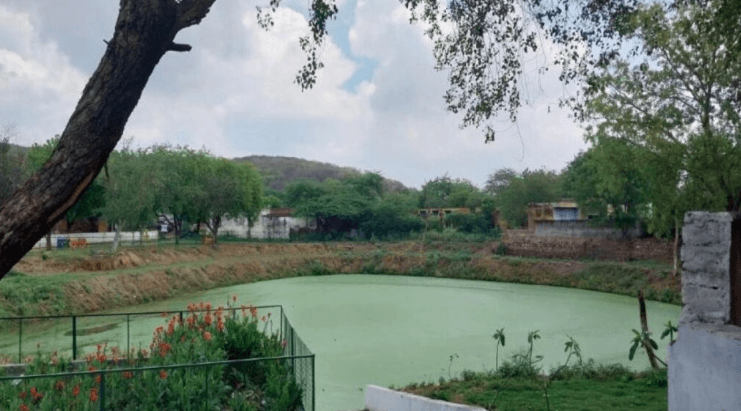
Popular videos and regional reporting often describe Sisai as home to a 45-acre bathroom, a phrase that understandably attracts attention. In reality, this refers not to a modern bathroom, but to a massive water tank or johad, traditionally used for bathing, rituals, livestock, and water storage.
Such large communal water bodies were once common in semi-arid Haryana, but few survive at this scale today.
5.2 Physical presence today
The present-day pond in Sisai occupies a vast open area with visible embankments and catchment structures. It continues to serve multiple functions—supporting agriculture, cattle, and local rituals—while also standing as a geographical reminder of Sisai’s historic scale and resource management.
There is limited documented evidence of surviving stone masonry, but the sheer size of the water body sustains the belief that it was once an exceptionally ambitious construction.
5.3 Symbolic importance
For residents, the pond is more than a water source. It is a symbolic anchor used to explain Sisai’s greatness—often cited when locals say, “Hamare gaon mein 45 acre ka snan ghar tha.” Whether viewed as history or heritage myth, it reinforces the idea of Sisai as a village that has always thought big.


6. Social Fabric: Khap, Khel & High-Profile Personalities
6.1 Kaliraman Khap and Collective Authority
Sisai is widely recognised as the central village of the Kaliraman Jat clan, one of the most influential gotras in this part of Haryana. Over decades, Sisai has functioned as the headquarters of the Akhil Bharatiya Kaliraman Khap, giving it a level of socio-political influence that extends far beyond its physical boundaries.
Khap panchayats originating in Sisai have historically addressed issues such as land disputes, marriage alliances, inter-village conflicts, and collective representation before district and state authorities. While khaps across Haryana have often been criticised—especially regarding gender-related decisions—Sisai’s leadership structure is locally viewed as a mechanism of cohesion and order in a village too large for informal mediation alone.
From an E-E-A-T perspective, it is important to separate documented influence from romanticised portrayals. Sisai’s khap does not replace the constitutional system, but it undeniably shapes social norms, electoral mobilisation, and dispute resolution at the grassroots level.
6.2 Wrestling Culture and Sporting Legacy
Sisai occupies a unique place in Haryana’s sporting geography because it is the birthplace of Chandgi Ram, one of India’s most celebrated wrestlers and a former Hind Kesari. Awarded the Padma Shri, Chandgi Ram is remembered not only for his victories in the akhara but also for his role in popularising traditional wrestling as a disciplined way of life.
The presence of multiple akharas in Sisai reflects this legacy. Young boys often begin training in wrestling alongside formal education, and physical fitness remains a deeply ingrained cultural value. Even today, Sisai is frequently referred to in regional sports circles as a “kushti gaon”—a village that produces wrestlers, soldiers, and athletes.
Beyond wrestling, Sisai has contributed personnel to the Indian Army, paramilitary forces, police services, and state sports academies, reinforcing its identity as a village where physical endurance and discipline are prized social traits.
6.3 Education and Local Institutions
Formal education in Sisai dates back to the mid-1940s, when a middle school was established. Over time, this expanded into:
- A senior secondary school for boys
- A separate senior secondary school for girls (established in the early 2000s)
These institutions serve not only Sisai but also nearby hamlets, making the village an educational hub for the surrounding rural belt. While higher education still requires migration to Hansi, Hisar, or Rohtak, Sisai’s schools are credited locally with improving literacy and enabling entry into defence services and government employment.
7. Governance Without a Police Station: Unity as Security
7.1 A Rare Claim in Rural Haryana
One of Sisai’s most frequently repeated claims is that it is among the largest villages in Haryana without its own police station. Law-and-order jurisdiction formally lies with Hansi police, yet residents often cite the absence of a local thana as evidence of strong internal cohesion.
For minor disputes—property boundaries, family disagreements, or agricultural conflicts—issues are typically resolved through community elders, panchayat members, or khap-mediated dialogue. Serious criminal cases, of course, are referred to the formal police system.
7.2 Strengths and Limitations
From a governance standpoint, this system has both advantages and risks:
Strengths
- Faster resolution of everyday disputes
- Lower litigation costs
- Strong sense of collective responsibility
Concerns
- Potential bias against women or marginalised groups
- Lack of procedural safeguards
- Dependence on social conformity
A balanced E-E-A-T approach recognises that while Sisai’s model has worked locally, it cannot substitute for institutional justice, especially as the village continues to grow in population and complexity.
8. Economy & Land Use: How a Giant Village Functions
8.1 Agricultural Backbone
Sisai’s size is inseparable from its land base. With over 2,000 hectares in Sisai Kali Rawan alone, agriculture remains the dominant economic activity. Major crops include:
- Wheat (rabi season staple)
- Mustard
- Cotton
- Guar (cluster bean)
Irrigation is supported by a combination of canal water from the Western Yamuna Canal system and private tubewells. The scale of cultivation allows Sisai to function almost like a mini-agricultural block, with daily movement of produce to mandis in Hansi and Hisar.
8.2 Workforce Structure
Census-linked data from Sisai Bola reveals a typical rural workforce pattern:
- Cultivators and agricultural labourers form the core
- A smaller but growing section works in government services, transport, construction, and small businesses
- Marginal workers and seasonal labour reflect agriculture’s cyclical nature
When extrapolated across both panchayats, Sisai’s economy shows diversification without de-agrarianisation—farming remains central, but alternative income sources are increasingly important.
8.3 Sisai as a Rural Hub
Because of its size, Sisai also acts as a service centre for nearby villages. Daily buses, private transport, coaching centres, sports facilities, and informal markets reinforce its role as a village that performs town-like functions without being administratively classified as one.
9. “Biggest Village in Haryana”: Exam GK vs Official Data
9.1 What Competitive Exams Say
In Haryana-focused GK material and competitive exams, questions such as “Which is the biggest village of Haryana?” are routinely answered with Sisai (Sisai Kali Rawan). This consensus appears across multiple exam platforms and preparation guides.
9.2 Cross-Checking with Census Evidence
Official data supports why this claim persists:
- Sisai Kali Rawan
- Area: ~2,085 hectares
- Population: 7,312
- Sisai Bola
- Population: 7,027
Combined population: ~14,339, placing Sisai among the largest village clusters in the state by headcount, while Sisai Kali Rawan alone ranks among the largest by area.
However, it is also true that Haryana does not publish an official “largest village” ranking by area, which means the claim should be framed as “widely regarded” rather than absolute.
9.3 Responsible E-E-A-T Framing
The most accurate formulation is:
Sisai (Sisai Kali Rawan along with Sisai Bola) is widely regarded as Haryana’s biggest village, based on its exceptional land area and combined population, and is consistently cited as such in exam and GK sources.
This phrasing maintains authority without overstating certainty.
10. Contemporary Challenges & Future Prospects
10.1 Key Development Challenges
Despite its strengths, Sisai faces several issues common to large rural settlements:
- Gender imbalance, especially in Sisai Kali Rawan
- Pressure on groundwater resources
- Limited access to local higher education and healthcare
- Dependence on nearby towns for advanced services
10.2 Emerging Opportunities
Sisai also holds significant potential:
- Heritage tourism centred on its Indus Valley association and large historic pond
- Sports development, leveraging its wrestling legacy
- Educational expansion, positioning itself as a rural learning hub
- Documentation of community-based governance reforms
If approached responsibly, these opportunities could allow Sisai to modernise without losing its social fabric.
11. Conclusion: A Village That Thinks at District Scale
Sisai is not merely Haryana’s biggest village in an exam answer. It is a mega-village—one that combines ancient habitation, vast agricultural land, strong social institutions, and a population large enough to resemble a small town.
Its story illustrates how rural India can scale without becoming urban, retaining identity while absorbing modern roles. For researchers, policymakers, and students of rural sociology, Sisai offers a rare lens into what happens when a village grows not just in size, but in historical depth, influence, and ambition.In many ways, Sisai is a village that lives at district scale—and that is precisely what makes it one of Haryana’s most fascinating rural settlements.
Latest Post
 City Of Peace In India
9/14/2026
 Highest Tax Paying City In India
9/13/2026
 City Of Light In India
9/12/2026
 City Of Hills In India
9/11/2026
 City of Gods in India
9/10/2026