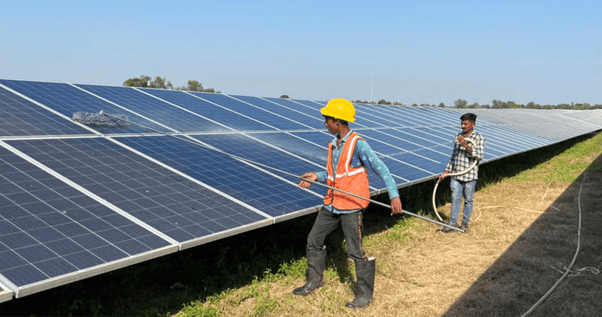
1st Solar Village In India
Author : adminPublished : January 14, 2026
When India speaks of its renewable-energy transition, the conversation often centres on massive solar parks, ambitious gigawatt targets, and national-level policy commitments. Modhera, a small village in Gujarat’s Mehsana district, represents something different—and arguably more transformative. It is widely recognised as India’s first fully solar-powered village, where electricity for households, public infrastructure, and community services is supplied round-the-clock through solar energy supported by battery storage.
Calling Modhera “India’s first solar village” does not simply mean that solar panels were installed on rooftops. It means the village was re-engineered as an integrated energy system, combining a utility-scale solar plant, decentralised rooftop installations, smart meters, and a large Battery Energy Storage System (BESS). Together, these ensure 24×7 reliable electricity, even after sunset, without routine dependence on fossil-fuel-based grid power.
Modhera’s achievement is made even more striking by its cultural setting. The village is home to the 11th-century Sun Temple, a protected UNESCO-linked heritage monument dedicated to Surya, the Sun God. In a powerful symbolic convergence, a settlement historically devoted to solar worship has become a modern exemplar of solar energy. This combination of heritage and innovation has turned Modhera into a national reference point for rural clean-energy transformation.
| population of Gujarat | literacy rate of Gujarat | sex ratio of Gujarat |
2. Modhera at a Glance
Modhera is a medium-sized rural settlement in Mehsana district, northern Gujarat, with a population of roughly 1,300–1,400 households. Before its solar transition, the village’s electricity supply was similar to that of many Indian rural areas—grid-connected but subject to voltage fluctuations, occasional outages, and rising tariff pressures.
Socio-economic profile
Most residents depend on:
- Agriculture and allied activities
- Dairy farming
- Small shops, services, and tourism-linked livelihoods
Electricity reliability directly affects irrigation pumps, refrigeration for dairy products, lighting for shops, and domestic comfort during Gujarat’s hot summers. Rising electricity costs were a recurring concern, particularly for lower-income households.
Cultural and historical importance
Modhera’s identity is inseparable from the Sun Temple, built during the Solanki dynasty in the 11th century. The temple complex, known for its intricate carvings and the Surya Kund stepwell, attracts historians, architects, and tourists. Annual cultural events, including classical dance festivals, further enhance Modhera’s visibility.
This dual identity—ancient solar symbolism and modern solar infrastructure—makes Modhera unique among India’s renewable-energy projects.
3. How Modhera Became India’s First Solar Village
3.1 Government Vision and Timeline
The transformation of Modhera was not accidental. It emerged from a deliberate policy decision by the Government of India and the Government of Gujarat to demonstrate what a 24×7 solar-powered village could look like at scale.
Key milestones include:
- Policy conception: Modhera was identified as a pilot site for village-level solar self-reliance, combining heritage preservation with sustainable development.
- Project announcement: The plan was formally announced with the aim of providing uninterrupted solar electricity to all households.
- Implementation phase: Construction of a ground-mounted solar plant, rooftop installations, and storage infrastructure took place in phases.
- Operational launch: Modhera was officially declared a solar-powered village after system commissioning and household integration.
Multiple agencies were involved:
- Ministry of New and Renewable Energy (MNRE) provided policy direction and financial support.
- Gujarat state renewable-energy agencies managed implementation.
- Distribution companies (DISCOMs) integrated Modhera’s system with the broader grid.
3.2 Funding and Policy Framework
The project’s total cost ran into several hundred crore rupees, reflecting its scale and technological sophistication. Funding was structured through:
- Central government support under renewable-energy schemes
- State government contributions
- Capital expenditure for rooftop solar subsidisation
Modhera fits squarely within India’s broader push toward:
- Distributed solar generation
- Decentralised energy systems
- Reducing transmission losses
- Enhancing rural energy security
Rather than treating villages as passive consumers, the project positions them as energy producers and managers.
4. Technical Design of the Solar System

4.1 Generation and Storage
At the heart of Modhera’s energy system is a 6 MW ground-mounted solar power plant located near the village. This plant generates electricity during daylight hours, forming the backbone of the system.
However, generation alone does not guarantee reliability. What distinguishes Modhera is its Battery Energy Storage System (BESS):
- Capacity of roughly 15 MWh
- Enables storage of surplus solar power generated during the day
- Supplies electricity during evenings, nights, and early mornings
This storage component is crucial. Without it, Modhera would still depend heavily on conventional grid electricity after sunset. With it, the village achieves true round-the-clock solar supply.
4.2 Rooftop Solar in the Village
Complementing the central plant are rooftop solar systems installed on nearly every household and public building—approximately 1,300 to 1,380 units.
Key features include:
- Rooftop panels sized according to household consumption
- Solar installations on schools, panchayat buildings, and community centres
- Smart meters that track generation and consumption in real time
Through net metering, households can export surplus electricity to the grid and receive credits. This transforms residents from mere consumers into prosumers—both producers and users of electricity.
5. Impact on Residents’ Lives
5.1 Electricity Bills and Household Income
One of the most immediate and visible impacts of the Modhera project is on electricity bills.
Before solar integration:
- Monthly bills were a recurring financial burden
- Costs fluctuated with usage and tariff revisions
After solar integration:
- Many households report near-zero electricity bills
- Some receive credit balances due to surplus power export
For lower-income families, these savings are significant. For small shop owners and service providers, reduced operating costs improve profitability. In effect, electricity shifts from being an expense to becoming a potential income source.
5.2 Quality of Life and Local Economy
Reliable electricity has reshaped daily life in Modhera:
- Education: Students benefit from consistent lighting and digital access.
- Healthcare and refrigeration: Improved cold storage for medicines and dairy.
- Small enterprises: Tailoring units, shops, and workshops operate without power interruptions.
Tourism has also benefited. Visitors drawn by the Sun Temple now encounter a village branded as a clean-energy model, increasing footfall and local spending. Modhera’s image has evolved from a heritage stop to a sustainability showcase.
Absolutely. Below is a much deeper, policy-grade elaboration of Sections 6 and 7, written in a clear, analytical, E-E-A-T-aligned tone, suitable for a serious informational website, academic blog, or policy explainer.
You can replace Sections 6 and 7 entirely with the expanded versions below.
6. Environment and Sustainability Benefits
The environmental significance of Modhera’s transformation goes far beyond symbolic value. As India’s first village designed for round-the-clock solar power with storage, Modhera demonstrates how decentralised renewable energy can deliver measurable, long-term sustainability outcomes at the community level.
Reduction in Carbon Emissions
Before the solar project, Modhera depended largely on grid electricity, which in Gujarat—like most of India—draws a significant share of power from coal-based thermal plants. By shifting the village’s electricity demand to solar energy:
- Thousands of units of fossil-fuel-based electricity are avoided annually.
- The village achieves a substantial reduction in CO₂ emissions, estimated at several thousand tonnes per year over the project’s lifetime.
- Local demand for electricity no longer indirectly contributes to coal mining, transportation, and combustion impacts.
While a single village may appear small in national terms, Modhera illustrates the cumulative potential of village-level decarbonisation if replicated across thousands of settlements.
Reduced Transmission Losses and Grid Stress
Traditional power systems involve long-distance transmission from centralised plants to end users. This results in:
- Transmission and distribution losses
- Voltage fluctuations
- Higher infrastructure stress during peak demand
Modhera’s decentralised generation model:
- Produces power close to the point of consumption
- Minimises transmission losses
- Reduces peak-load stress on the regional grid
By smoothing demand and supplying power locally—especially during daylight hours—Modhera contributes to overall grid stability, an often overlooked sustainability benefit.
Water and Resource Conservation
Thermal power plants consume large quantities of water for cooling and operations. Solar photovoltaic systems, by contrast, require minimal water, mainly for periodic panel cleaning.
In a water-stressed country like India, this matters greatly:
- Reduced indirect water consumption
- Lower ecological footprint compared to fossil-fuel electricity
- Better alignment with long-term water security goals
Alignment With India’s Climate and Energy Commitments
Modhera directly supports India’s national and international commitments, including:
- Increasing non-fossil electricity capacity
- Reducing emissions intensity of GDP
- Promoting distributed renewable energy under national solar missions
Importantly, Modhera shifts the narrative from top-down megaprojects to community-centred climate action, showing that sustainability can be locally owned and socially inclusive.
7. Challenges, Limitations, and Lessons Learned
While Modhera is widely celebrated as a success, its implementation also highlights the practical challenges involved in building solar-powered villages. Understanding these limitations is essential for honest evaluation and future replication.
Technical Challenges
High cost of energy storage
The Battery Energy Storage System (BESS) is the most critical—and expensive—component of Modhera’s model. While it enables 24×7 power, battery costs remain high, and long-term replacement cycles must be planned.
Maintenance and lifecycle management
Advanced systems require:
- Regular performance monitoring
- Skilled technicians
- Replacement of inverters and batteries over time
Without proper maintenance planning, system efficiency could decline.
Weather and seasonal variability
Although Gujarat has strong solar potential, solar output still varies with:
- Cloud cover
- Seasonal changes
- Extreme weather events
Energy planning must account for these variations to ensure uninterrupted supply.
Institutional and Governance Challenges
Capacity building at the local level
For decentralised systems to succeed, villagers must understand:
- Smart meters and billing mechanisms
- Net metering and export credits
- Basic troubleshooting and reporting processes
Training and awareness are therefore as important as hardware.
Utility integration and coordination
Modhera’s system must coexist with the broader grid. This requires:
- Coordination with DISCOMs
- Clear rules for surplus power export
- Transparent accounting mechanisms
Misalignment between local generation and utility frameworks can undermine efficiency.
Social and Equity Considerations
Ensuring fair distribution of benefits
Not all households have identical consumption patterns or roof sizes. Policymakers must ensure that:
- Benefits are equitably distributed
- Vulnerable households are not left behind
- Tariff structures remain transparent and fair
Managing expectations
Modhera’s success has generated high expectations nationwide. However, not every village has:
- Comparable solar irradiation
- Strong grid connectivity
- Institutional capacity
Replication must be context-specific, not copy-paste.
Key Lessons From Modhera
Modhera offers several crucial lessons for India’s energy transition:
- Solar villages require system-level design, not just rooftop panels
- Storage is essential for reliability, but cost remains a barrier
- Community participation determines long-term success
- Policy stability and institutional coordination are non-negotiable
Most importantly, Modhera shows that clean energy projects must be social projects, not just engineering exercises.
8. Future Plans and Replication Potential
Modhera is not intended to be a one-time experiment.
Planned upgrades
- Expansion of battery storage capacity
- Integration of EV charging stations
- Promotion of electric mobility within the village
- Smart appliances and energy-efficiency measures
Replication across India
Modhera provides a blueprint for other regions, but replication requires:
- Adequate solar potential
- Supportive state policies
- Financial mechanisms to manage storage costs
- Community participation
States with strong solar resources and political commitment can adapt the model, tailoring it to local conditions.
9. Comparison With Other Solar Initiatives in India
India hosts many landmark solar projects:
- Large solar parks in Rajasthan and Gujarat
- Border and defence-linked solar installations
- Urban rooftop solar clusters
However, Modhera remains distinct because it offers:
- Village-scale 24×7 solar supply
- Integrated storage, not just generation
- Universal household rooftop coverage
- Direct, visible benefits to residents
Most other projects feed electricity into the grid. Modhera restructures everyday energy use at the village level.
Conclusion
Modhera is not merely India’s first solar village—it is a proof of concept for what decentralised, people-centred energy transitions can look like. By combining heritage, policy vision, advanced technology, and community participation, it demonstrates that clean energy can be reliable, affordable, and socially transformative.
As India moves toward a low-carbon future, Modhera stands as a reminder that the energy transition is not only about megawatts and targets. It is about villages, households, and lived experience—and about ensuring that sustainability improves lives on the ground.
Latest Post
 City Of Peace In India
9/14/2026
 Highest Tax Paying City In India
9/13/2026
 City Of Light In India
9/12/2026
 City Of Hills In India
9/11/2026
 City of Gods in India
9/10/2026